
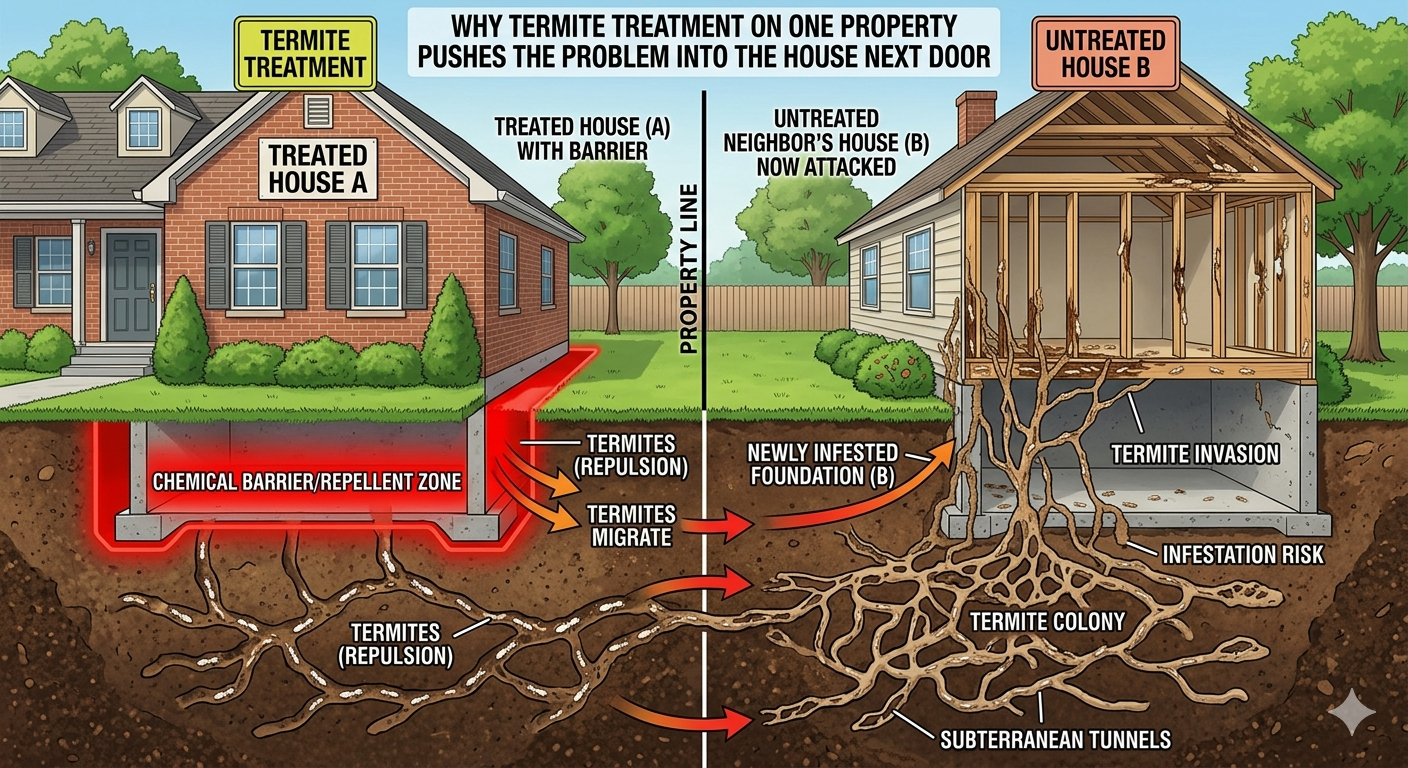

It is a situation many homeowners find confusing. One property undergoes treatment, the termite activity seems to stop, and within months, a neighbour starts noticing damage. It can feel like the problem has somehow shifted rather than been resolved. This is not just a coincidence. In many cases, termite pest control disrupts existing termite pathways without eliminating the entire colony, which can lead to movement into nearby structures. Understanding how termites behave explains why treating one property does not always isolate the issue, and why neighbouring homes can suddenly become part of the same problem.
How Termite Colonies Actually Operate
Termites do not exist as isolated insects. They live in large, organised colonies that are usually hidden underground or inside timber structures. These colonies can contain thousands to millions of termites working together to find food and expand their territory.
One of the key characteristics of termite behaviour is their ability to cover large areas. A single colony can forage across distances of 60 to 90 metres, sometimes spanning multiple properties. This means the termites feeding on timber in one home may actually belong to a colony located beneath a neighbouring yard.
They travel through underground tunnels, cracks in foundations, and even shared structural elements. Because of this, property boundaries do not limit termite movement. From the colony’s perspective, multiple homes can simply be part of the same food source network, which makes any effective termite inspection a matter that often extends beyond one household.
What Happens During Termite Treatment
When a property is treated, the goal is usually to create a barrier or eliminate active termites in that specific area. This often involves chemical treatment applied to soil or timber to disrupt termite activity.
While these treatments are effective in reducing activity within the treated zone, they do not always destroy the entire colony, particularly if the nest is located elsewhere. Instead, the treatment interrupts the termites’ established pathways.
When their access to one area is blocked, termites do not stop searching for food. They simply change direction. Their behaviour is driven by survival, and when a familiar route is no longer available, they begin exploring alternative paths. This is where the issue begins to shift. The treatment works locally, but the colony remains active and continues to forage.
Why Termites Move to Nearby Properties
Once a treated barrier disrupts their movement, termites naturally look for new entry points. If neighbouring properties are close, which is common in suburban and terrace-style housing, those homes become the next available option.
Termites are highly adaptable. They can reroute through soil, find cracks in adjacent foundations, or access timber through shared structures. If one property becomes difficult to access, the colony simply redirects its activity toward another.
Proximity is another factor. When homes are built close together, the distance between potential food sources is minimal. A colony does not need to travel far to reach untreated timber. In some cases, winged termites known as swarmers can also establish new colonies nearby. These reproductive termites leave an existing colony and settle in new locations, increasing the spread of a termite infestation across neighbouring properties.
Risks for Neighbouring Homes
For neighbouring homeowners, this shift in activity can feel sudden. A property that previously showed no signs of termites may begin to experience damage shortly after treatment occurs nearby. The risk is not just limited to new infestations. Existing low-level activity in neighbouring homes can intensify when termites are pushed away from treated areas. This increases the likelihood of serious termite damage over time.
Awareness is another issue. Many homeowners assume termite problems are isolated. As a result, they may not take preventive action until visible damage appears, by which point the infestation may already be well established. This creates a cycle where treatment in one property indirectly contributes to increased pressure on surrounding homes.
Why Area-Wide Termite Management Is Important
The key to breaking this cycle is understanding that termite control should not always be approached as a single-property solution. Because colonies operate across larger areas, managing them effectively often requires a broader strategy.
Coordinated inspections across neighbouring properties can help identify the extent of termite activity. This allows for a more accurate understanding of where the colony is located and how it is spreading. Preventive measures such as regular inspections, monitoring systems, and early detection play a critical role. When multiple properties take action together, the chances of disrupting the entire colony increase significantly.
Long-term termite protection focuses on controlling termite movement rather than simply reacting to visible damage. This includes addressing moisture issues, sealing entry points, and maintaining consistent monitoring over time.
Conclusion
Termite activity does not follow property boundaries. Treating one home can reduce damage in that space, but it does not always eliminate the underlying colony. Instead, it can redirect termite movement into nearby properties that remain untreated. This is why infestations often appear to spread after local treatment. A broader, coordinated approach is more effective in managing termite activity and reducing long-term risk. Understanding how termites behave is the first step in preventing the problem from simply moving next door.
FAQs
Can termites move from one house to another? Yes. Termites can travel through soil, tunnels, and structural gaps, allowing them to move between nearby properties with ease.
Does termite treatment eliminate the entire colony? Not always. Some treatments target specific areas rather than destroying the full colony, particularly if the nest is located elsewhere.
Why do neighbours get termites after treatment nearby? Treatment can disrupt termite pathways, causing them to search for new food sources in adjacent properties.
How far can termite colonies spread? A single colony can cover large areas, sometimes extending across multiple properties within a radius of several hundred metres.
Should neighbouring homes be inspected together? Yes. Coordinated inspections help identify shared termite activity and improve the effectiveness of control measures.
What is the best way to prevent termite spread? Regular inspections, early detection, and area-wide management strategies are the most effective ways to reduce termite movement and damage.