
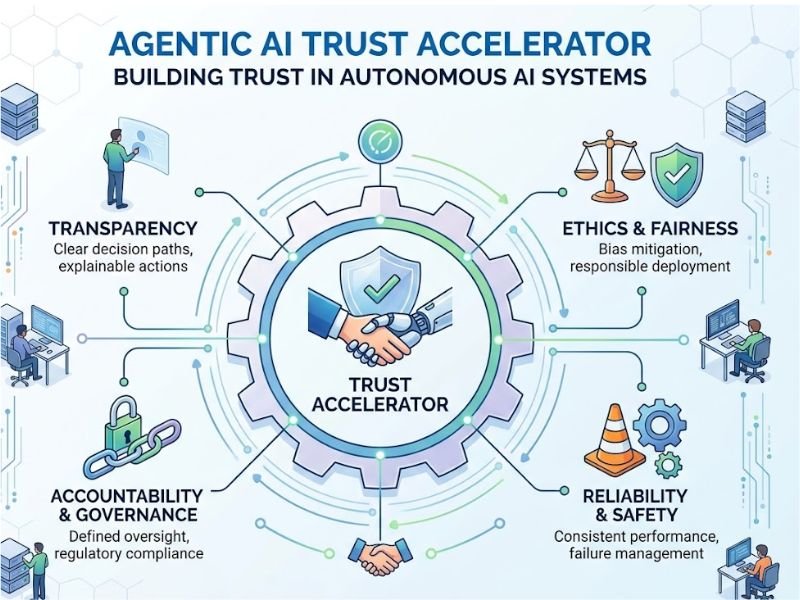

Artificial intelligence is moving beyond simple chatbots and content-generation tools toward systems that can plan tasks, make decisions, use software, and complete actions with limited human intervention. These systems are commonly described as agentic AI. As organizations begin using autonomous AI for customer service, business operations, research, software development, and other workflows, trust becomes an essential part of adoption. The Agentic AI Trust Accelerator represents an approach to helping organizations develop confidence in autonomous AI systems through testing, monitoring, governance, transparency, and responsible deployment. By focusing on trust from the beginning, businesses can better understand how AI agents behave and create safeguards for situations where human oversight is needed.
What Is the Agentic AI Trust Accelerator?
The Agentic AI Trust Accelerator is meant to build more confidence in AI agents that can work through multi step goals on their own. In many older AI apps, the system just answers what you ask. Agentic systems can go further. They take a stated aim, set out a plan, call tools, check results, and then do more than one action to finish the work.
That extra independence can be helpful. It also brings fresh risks. So the trust angle is about more than comfort. It pushes teams to see if the agent acts in a way that fits what they expect. It also looks at whether the agent sticks to clear rules, handles private data with care, and gives enough visibility into what it is doing. The point is to make these autonomous systems easier to manage and easier to hold to account. This matters as organizations start using them inside real daily workflows.
Why Trust Matters in Agentic AI
When AI can do things, trust matters a lot more than it does for simple advice. For example, an agent tied into business tools might send messages, change files, read data sets, or start workflow steps. If the agent gets an instruction wrong, or returns a bad output, the harm can go past a wrong answer.
Because of that, teams need a way to judge how dependable the agent is before they let it touch key systems. The Agentic AI Trust Accelerator focuses on this. It highlights checking how the agent behaves, setting clear limits, and putting controls in place to lower risk. Trust should not mean you assume the system is always right. It is more about knowing what it can do and where it can fail.
Key Elements of the Agentic AI Trust Accelerator
A good trust setup for autonomous AI usually has a few key parts. One part is testing. It lets teams see how an agent acts in normal cases and in odd or rare cases too. After that, there is monitoring. This is what shows what the system is doing once it is live. You also need governance. This sets the rules for who can use data, how choices are made, and what kind of AI use is allowed.
Next comes human oversight. People should be able to look at what the agent is doing. They should also step in if the agent hits a risky or unclear moment. There should be security controls as well. These limits can keep an agent from touching sensitive systems or private data. When these pieces work together, you get a clear way to manage autonomous AI. You do not have to rely only on the base model under the hood.
Testing and Evaluating AI Agents
Testing is one of the most important parts of building trustworthy autonomous AI. Organizations should evaluate agents using realistic scenarios that represent the tasks they will perform in production. Testing can examine whether an agent follows instructions, handles ambiguous requests, uses tools correctly, and responds appropriately when information is missing. Edge cases are also important because autonomous systems may encounter situations that were not included in their original instructions. The Agentic AI Trust Accelerator approach encourages organizations to evaluate agents before expanding their permissions. Continuous testing can also help identify changes in behavior when models, tools, data sources, or workflows are updated.
Monitoring Autonomous AI Systems
Checking in a lab does not cover everything, since an AI agent may act in new ways once it is live. After release, teams still need to watch it. This can include event logs, notes on what tools were used, and messages from failed system checks. It can also cover policy breaks, odd patterns in how the agent acts, and times when a person stepped in.
When teams have this data, they can dig into why something went wrong. They can also use the findings to tune the system and make it work better. It helps to set clear limits in advance. For example, decide when a human must review the agent. Also decide when the safe move is to stop the automated steps. With solid monitoring, leaders get a clearer view of what the agent is doing. Then they can react faster when the agent drifts outside what it is supposed to do.
Human Oversight and Control

Human oversight remains important even when an AI agent is designed to operate autonomously. Not every decision should be handled automatically, particularly when it involves sensitive information, financial consequences, legal requirements, or significant effects on customers and employees. Businesses can establish approval steps that require human confirmation before certain actions are completed. Other workflows may allow an agent to operate independently within clearly defined limits while escalating unusual situations to a person. The Agentic AI Trust Accelerator concept supports this balance by treating autonomy as something that should be controlled according to the risk of the task rather than applied equally to every workflow.
Security and Data Protection
Autonomous AI agents can raise new security risks since they may touch many apps, data stores, and outside tools. When an agent is given too much access, a mistake or a security flaw can spread to several connected systems. Teams should use the least privilege rule. That means granting the agent only what it truly needs to do its job.
It also matters how access is handled. Use strong login checks and proper role rules. Keep data encrypted while it is sent and stored. Track actions with clear logs. Connect tools in a safe way, not in an ad hoc manner. Throughout the agent workflow, protect any sensitive data. Security tests should cover more than the AI model. Test the tools, the APIs, the databases, and the apps the agent may use.
Transparency and Explainability
Organizations need visibility into how AI agents reach decisions and complete tasks. Complete technical explanations may not always be possible for complex AI models, but systems can still provide useful records of actions, tool calls, inputs, outputs, and decisions. Clear documentation can help employees understand what an agent is allowed to do and when human intervention is required. Transparency is particularly valuable when an AI system makes an unexpected decision. The Agentic AI Trust Accelerator approach can support this by encouraging organizations to create processes that make autonomous actions easier to review and investigate.
Benefits for Businesses
A structured trust approach can help businesses adopt agentic AI more responsibly. Organizations may be able to automate repetitive workflows while maintaining appropriate controls over important decisions. Better testing and monitoring can also make it easier to identify problems before they become larger operational issues. Employees may have greater confidence in AI tools when they understand how the systems are monitored and where human oversight exists. In addition, clear governance can help organizations establish consistent rules for deploying AI across different departments. Trust therefore becomes part of the operational foundation for scaling autonomous AI rather than something addressed only after deployment.
Challenges of Building Trust in Agentic AI
Building trustworthy autonomous AI is not without challenges. AI agents can interact with complex environments, and it may be difficult to anticipate every possible scenario before deployment. Organizations must also balance automation with human oversight without creating unnecessary delays. Monitoring large numbers of AI actions can require additional infrastructure and technical expertise. Privacy, cybersecurity, regulatory requirements, and model reliability can add further complexity. Businesses should therefore treat trust as an ongoing process that evolves as AI capabilities and organizational needs change.
The Future of Agentic AI Trust
As autonomous AI becomes more capable, trust and governance are likely to become increasingly important. Future systems may operate across multiple applications and coordinate complex workflows with limited human involvement. Organizations will need reliable methods for testing these systems, monitoring their actions, controlling permissions, and reviewing high-impact decisions. The Agentic AI Trust Accelerator concept reflects the broader need to develop responsible foundations alongside AI capabilities. Businesses that build evaluation and governance into their AI strategies can create clearer boundaries for autonomy while continuing to explore new opportunities.
Conclusion
The Agentic AI Trust Accelerator highlights the importance of trust when organizations deploy autonomous AI systems. Agentic AI can perform complex tasks and interact with business tools, but greater autonomy also requires stronger testing, monitoring, security, governance, and human oversight. A structured approach can help businesses understand how their AI agents behave and establish appropriate controls before expanding their capabilities. As autonomous AI continues to develop, building trust into the design and deployment process will remain an important part of creating reliable and responsible AI-powered workflows.
FAQs
What is the Agentic AI Trust Accelerator?
The Agentic AI Trust Accelerator is a trust-focused approach for evaluating and managing autonomous AI agents through testing, monitoring, governance, security, and human oversight.
Why is trust important for agentic AI?
Trust is important because AI agents can perform actions and interact with external systems. Organizations need to understand their capabilities and establish controls to manage potential errors and risks.
How can businesses test AI agents?
Businesses can test agents using realistic scenarios, edge cases, security assessments, and performance evaluations before and after deployment.
Does agentic AI require human oversight?
The level of human oversight depends on the task and its potential impact. High-risk or sensitive actions may require human approval, while lower-risk tasks can operate within predefined limits.
How can organizations secure AI agents?
Organizations can use restricted permissions, strong authentication, authorization controls, monitoring, secure integrations, logging, and regular security testing to reduce risks.