

AI tools have changed the way people research, write, and publish content online. Although these tools can save time, they can also produce text that feels repetitive, overly polished, or lacking in personal experience. For this reason, many businesses, editors, teachers, and website owners want to know how to spot AI-written content before publishing it. Identifying AI-generated text is not always simple because modern writing tools can create natural-sounding paragraphs. However, by examining sentence patterns, originality, accuracy, tone, and structure, it becomes easier to recognize content that may have been produced by artificial intelligence.
What Does It Mean to Spot AI-Written Content?
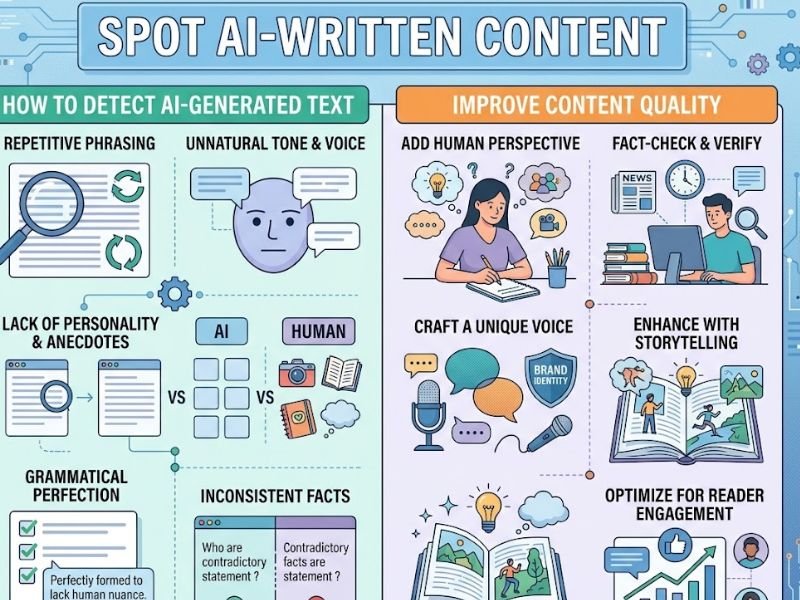
To spot AI-written content means identifying signs that a text may have been created or heavily assisted by an artificial intelligence writing tool. AI-generated content often follows predictable patterns, including similar sentence lengths, repeated phrases, general explanations, and limited personal opinions. Some articles may also contain broad statements without real examples or reliable sources. However, no single sign proves that content was written by AI. Human writers can also produce repetitive or formal text, while AI-assisted content can be edited to sound highly natural. Therefore, the best approach is to review several characteristics together instead of relying on one clue.
Common Signs of AI-Generated Text
One of the most noticeable signs of AI-generated writing is repetition. AI tools sometimes repeat the same idea in different words, especially when explaining a topic in detail. For example, a paragraph may mention that a product is useful, efficient, and convenient without adding specific evidence. Another common sign is the use of predictable introductory phrases such as “in today’s digital world,” “it is important to note,” or “whether you are a beginner or an expert.” These phrases are not always incorrect, but frequent use can make an article feel generic.
Another sign is a lack of personal experience. Human-written content often includes real observations, individual opinions, practical examples, or details based on direct experience. AI-generated text may explain a subject accurately but still feel distant because it does not include a unique point of view. The writing may sound polished, yet it can fail to answer the reader’s most practical questions. When reviewing an article, check whether it contains original insights, specific examples, and information that goes beyond a basic summary.
Human-Written Content vs. AI-Written Content
Human-written content usually has a more varied rhythm. Some sentences may be short and direct, while others may be longer and more descriptive. The writer may use personal expressions, unexpected comparisons, or a distinctive tone. Human writing can also contain small imperfections that make it feel authentic. In contrast, AI-generated text often follows a highly organized structure with similar paragraph lengths and balanced transitions.
However, the difference is not always obvious. Skilled writers can use templates, grammar tools, and editing software, while AI-generated content can be revised by a human before publication. This is why readers should focus on the overall quality and originality of the article rather than assuming that formal writing is automatically AI-produced. The goal is not to reject content because it sounds polished. The goal is to determine whether the content is useful, accurate, original, and appropriate for its audience.
How to Detect ChatGPT Content
Many people want to detect ChatGPT content because ChatGPT is widely used for blog posts, product descriptions, academic drafts, and marketing materials. One way to review possible ChatGPT content is to look for overly general explanations. The text may answer the question correctly but avoid details that would make it more valuable. It may also use a repeated pattern such as defining a topic, listing benefits, explaining challenges, and ending with a broad conclusion.
Another method is to ask whether the article contains verifiable information. AI tools can sometimes create inaccurate facts, incorrect statistics, or unsupported claims. Check names, dates, technical details, product specifications, and references carefully. If an article includes information that cannot be confirmed through trustworthy sources, it should be edited before publication. Detecting ChatGPT content should therefore involve both style analysis and fact-checking.
It is also useful to examine whether the article responds directly to the reader’s search intent. AI-generated text may include many related keywords but fail to provide a clear answer. For example, a product review might describe general features without discussing real performance, limitations, pricing, or user experience. Strong content should provide practical information rather than simply repeating keywords in different sections.
Using AI Content Detection Tools

AI content detection tools analyze writing patterns to estimate whether text may have been generated by an AI system. These tools may examine sentence predictability, word choice, structure, and statistical patterns. Some platforms provide a percentage or probability score, while others highlight sections that appear machine-generated. AI content detection tools can be helpful during editorial reviews, but their results should never be treated as absolute proof.
A detector may incorrectly flag human-written content, especially when the writing is formal, short, or written by someone who is not a native English speaker. It may also fail to identify AI-generated content that has been carefully edited. Because of these limitations, editors should use detection tools as one part of a larger review process. The final decision should consider the writer’s drafts, research notes, sources, writing history, and the quality of the finished article.
How to Make AI-Assisted Content More Natural
AI-assisted content can become more useful when a human adds original research, personal experience, and a clear editorial voice. Instead of publishing the first generated draft, review every paragraph and remove unnecessary repetition. Replace vague claims with specific examples, practical recommendations, and supporting evidence. Add information that reflects the needs of the target audience.
Writers should also vary sentence structure and avoid using the same transition phrases throughout the article. A natural article does not need every paragraph to follow an identical format. Some sections can explain a concept, while others can answer a question, provide an example, or discuss a limitation. This variation makes the content easier to read and gives it a more authentic voice.
Fact-checking is equally important. AI tools can assist with research, but writers should verify important information through reliable sources. They should also avoid inventing testimonials, statistics, studies, or expert opinions. Originality means more than changing words. It means adding real value, accurate information, and a perspective that readers cannot find in every other article.
Why Originality Matters for SEO
Search engines aim to provide useful and relevant information to users. Content created only to manipulate rankings may perform poorly if it lacks originality, accuracy, or a clear purpose. AI-generated content is not automatically low quality, but publishing unedited text can create problems when it is repetitive, inaccurate, or written only for search engines.
High-quality SEO content should answer the user’s question, use keywords naturally, provide helpful headings, and offer information supported by experience or research. The keyword spot AI-written content can be included in the title, introduction, headings, and body, but it should never be repeated unnaturally. Keyword placement should support readability rather than interrupt it.
A Practical Review Process
A simple review process can help editors spot AI-written content more effectively. First, read the article without focusing on grammar. Ask whether the text sounds natural and whether it provides a clear point of view. Next, check for repeated ideas, generic phrases, unsupported claims, and missing examples. Then verify important facts and review the sources. Finally, compare the article with the writer’s previous work if that material is available.
This process is more reliable than using an AI detector alone. It also improves the article even when the content was written entirely by a human. The purpose of content review should be to improve usefulness, clarity, trust, and originality.
Conclusion
Learning how to spot AI-written content is becoming increasingly important for publishers, businesses, educators, and digital marketers. AI-generated text may contain repetitive language, general explanations, predictable structure, and limited personal insight. However, these signs are not conclusive on their own. Human review, fact-checking, originality checks, and careful use of AI content detection tools provide a more balanced approach. The strongest content combines the speed of modern writing technology with human judgment, real experience, accurate research, and a clear understanding of the reader’s needs.
FAQs
Can AI-written content be detected with complete accuracy?
No. AI detection tools can provide useful estimates, but they can produce false positives and false negatives. Human review is still necessary.
What is the easiest way to spot AI-written content?
Look for repetitive wording, generic statements, predictable structure, limited personal experience, and unsupported claims. Review several signs together rather than relying on one feature.
Are AI content detection tools reliable?
AI content detection tools can support editorial checks, but their results are not guaranteed. They should be used alongside fact-checking, source review, and quality assessment.
How can I make AI-generated text sound human?
Add original examples, personal insights, verified information, varied sentence structures, and a consistent brand or author voice. Remove repeated phrases and vague statements.
Does AI-generated content hurt SEO?
AI-generated content is not automatically harmful to SEO. Problems arise when content is inaccurate, repetitive, unhelpful, or created only to manipulate search rankings. High-quality and useful content should remain the priority.