


Introduction
The market for the 7 Best AI Smart Glasses is growing as wearable technology becomes smarter, more connected, and more practical. Unlike traditional glasses, today’s smart eyewear can combine cameras, microphones, speakers, wireless connectivity, and AI-powered features in a lightweight frame. For users interested in hands-free communication, photography, navigation, productivity, or entertainment, AI-powered smart glasses offer an interesting alternative to constantly reaching for a smartphone. At the same time, advances in AI wearable technology are creating new ways for people to interact with digital assistants and information throughout the day. While many current smart glasses focus on audio and AI rather than full visual overlays, augmented reality glasses are also advancing toward more immersive experiences.
What Are AI Smart Glasses?
AI smart glasses are wearable devices designed to combine conventional eyewear with digital technology. Depending on the product, they can include cameras for photos and video, microphones for voice commands, open-ear speakers for calls and music, and software that connects to AI assistants. Some devices also offer translation, visual recognition, navigation assistance, or other intelligent features.
One important distinction is that not every smart-glasses product is a full augmented-reality headset. Some provide AI and connectivity without displaying digital information over the user’s field of view. That difference is important when comparing the 7 Best AI Smart Glasses because the technology and intended use can vary considerably.
1. Meta Ray-Ban Meta Smart Glasses
The Ray-Ban Meta line is one of the most recognizable examples of AI-powered smart glasses designed for everyday use. The glasses combine a familiar eyewear style with cameras, microphones, speakers, and AI features. Depending on the current software and region, users can interact with Meta AI, capture hands-free photos and video, listen to audio, and make calls.
One major attraction is the balance between ordinary glasses and smart functionality. The frames are designed to look like conventional eyewear rather than a bulky technology product. They can be a particularly good choice for users who want hands-free content capture and voice-based AI without wearing a dedicated AR headset.
2. Solos AirGo Vision
Solos has developed smart glasses with a strong focus on AI-assisted interaction. The AirGo platform is designed to integrate voice-based assistance and visual capabilities into a wearable format. Depending on the configuration, users can interact with AI, access information, and use smart features while keeping their phones in a pocket.
The platform is particularly interesting because it shows how AI wearable technology can focus on practical assistance rather than only entertainment. For users who want glasses that can become part of a broader AI workflow, Solos is worth considering.
3. Even Realities G1
Even Realities takes a different approach from camera-first smart glasses. The G1 focuses on discreet information display, allowing selected digital information to appear through a transparent display while maintaining a glasses-like appearance. This makes the product more closely related to lightweight augmented reality glasses, although it is not intended to provide the same immersive experience as a full mixed-reality headset.
The concept is useful for people who want navigation prompts, notifications, translations, or other information without repeatedly checking a smartphone. Its minimalist design is also part of its appeal.
4. Brilliant Labs Frame
Brilliant Labs Frame is another example of wearable AI moving toward visual computing. The glasses are designed around an open and experimental approach, combining a lightweight frame with AI assistance and a display. This can make the product appealing to developers, technology enthusiasts, and users who are interested in experimenting with new forms of wearable computing.
The device illustrates how AI-powered smart glasses can become more than simple accessories by providing access to digital information in the user’s field of view. However, users should carefully review the current software capabilities and ecosystem before choosing a product focused on experimentation.
5. Ray-Ban Meta Gen 2
A newer generation of Ray-Ban Meta smart glasses offers an updated version of the everyday smart-eyewear concept. The emphasis remains on cameras, audio, voice interaction, and AI, while new hardware and software improvements can make the overall experience more practical.
For users considering the 7 Best AI Smart Glasses, the newer generation is especially relevant because it demonstrates how smart eyewear can evolve without becoming dramatically different from normal glasses. This approach may help encourage broader adoption because users do not need to change their appearance or learn a complicated interface.
6. Vuzix Z100
Vuzix approaches smart glasses from a more professional and enterprise-oriented perspective. The Z100 is designed around a see-through display that can provide information while allowing users to maintain awareness of their physical surroundings. This type of product demonstrates the potential of augmented reality glasses in workplace environments.
Possible applications include industrial instructions, logistics, remote support, field service, and other situations where workers need hands-free access to information. The value of enterprise smart glasses is often less about entertainment and more about helping workers complete specific tasks efficiently.
7. XREAL One Pro
XREAL’s smart eyewear products focus heavily on immersive visual experiences and spatial computing. The XREAL One Pro is closer to display-focused wearable technology than camera-first AI glasses. It can provide a large virtual viewing experience from a compact wearable format.
For consumers interested in the broader future of AI wearable technology, products like XREAL demonstrate another direction for smart eyewear: turning glasses into portable displays. Although this category is different from AI glasses that focus primarily on voice and cameras, it highlights how wearable computing is expanding into multiple product types.
How to Choose Among the 7 Best AI Smart Glasses
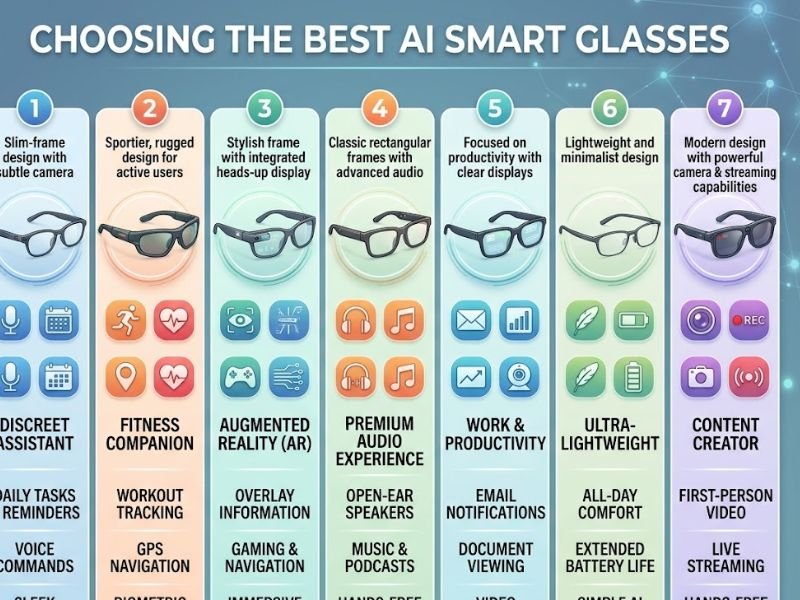
Choosing between the 7 Best AI Smart Glasses depends on how you expect to use the device. If you mainly want hands-free photos, calls, music, and AI assistance, camera-and-audio glasses may be the most practical option. If you want digital information to appear in front of your eyes, display-focused augmented reality glasses may be more suitable.
Before buying, consider camera quality, audio performance, AI capabilities, battery life, frame comfort, prescription-lens support, smartphone compatibility, privacy controls, and available apps. The smartest device on paper is not always the best choice for everyday use.
AI-Powered Smart Glasses for Content Creators
Creators have a strong reason to consider AI-powered smart glasses. Hands-free cameras can capture natural first-person footage without requiring a traditional camera setup. This can be especially useful for travel, events, outdoor activities, and behind-the-scenes content.
Open-ear speakers can also allow creators to interact with AI or receive calls while remaining aware of their surroundings. However, creators need to think about privacy and consent when recording around other people. A wearable camera should be used responsibly, especially in private or sensitive environments.
AI Wearable Technology and Everyday Productivity
The broader AI wearable technology market is moving toward more natural interaction. Instead of opening a phone to perform every small task, users can potentially ask a voice assistant a question, receive audio feedback, or view information through a wearable display. This could be useful for reminders, navigation, communication, translation, and quick information access.
The real advantage is not simply having AI on your face. It is reducing the number of steps needed to access useful information. That makes convenience one of the most important factors in determining whether smart glasses become a mainstream product.
Augmented Reality Glasses vs AI Smart Glasses
The terms can sound interchangeable, but there is an important difference. AI smart glasses may provide cameras, audio, voice assistance, and connectivity without placing digital graphics in front of the user’s eyes. Augmented reality glasses can go further by placing digital information within the user’s view of the physical environment.
AR requires additional hardware such as display systems, sensors, processors, and advanced software. For many consumers, camera-and-audio smart glasses are currently easier to wear throughout the day. As display technology improves, the difference between these categories may become less noticeable.
Privacy and Security Considerations
Privacy deserves serious attention when buying smart eyewear. Cameras and microphones can capture information from the surrounding environment, and cloud-connected AI services may process some user data. Before purchasing a device, review its privacy policy and understand how recordings and AI interactions are handled.
Users should also protect their connected accounts with strong passwords and multi-factor authentication where available. Manufacturers can provide recording indicators and privacy settings, but responsible use ultimately depends on the wearer.
Battery Life and Comfort
Battery life can strongly influence the daily experience. Recording video, using AI assistants, streaming audio, and maintaining wireless connectivity can all consume power. A device that requires frequent charging may become inconvenient.
Comfort is equally important. The glasses need to fit well, remain stable during movement, and avoid unnecessary weight. For many users, a slightly less advanced device that can be worn all day comfortably may be more valuable than a feature-heavy product that is rarely worn.
The Future of AI Smart Glasses
The future of the 7 Best AI Smart Glasses category is likely to include better AI assistants, improved cameras, longer battery life, smaller components, and more capable displays. AI could become more contextual, allowing glasses to understand what users are doing and provide relevant assistance at the right moment. Better AI wearable technology may also connect glasses with smartwatches, smartphones, earbuds, and other devices.
Meanwhile, augmented reality glasses could become more practical as display and battery technologies improve. The long-term goal is likely to create wearable devices that provide useful digital assistance without distracting users from the world around them.
Conclusion
The 7 Best AI Smart Glasses show that smart eyewear is developing in several different directions. Products such as Ray-Ban Meta, Solos, Even Realities, Brilliant Labs, Vuzix, and XREAL demonstrate different approaches to cameras, AI assistance, audio, visual displays, and spatial computing. AI-powered smart glasses are increasingly focused on practical everyday features, while AI wearable technology is making digital assistance more natural and accessible. At the same time, augmented reality glasses are pushing toward a future where digital information can appear directly within a user’s surroundings. When choosing smart glasses in 2026, focus on the features you will actually use, along with comfort, battery life, privacy, compatibility, and long-term software support.
FAQs
What are the 7 Best AI Smart Glasses in 2026?
The right choice depends on your needs. Popular categories include Meta’s Ray-Ban smart glasses, Solos, Even Realities G1, Brilliant Labs Frame, Vuzix Z100, and XREAL’s display-focused eyewear.
What can AI-powered smart glasses do?
AI-powered smart glasses can provide features such as hands-free photography, audio, calls, voice assistants, translations, and other AI-based functions depending on the model.
Are AI smart glasses the same as augmented reality glasses?
Not necessarily. Some AI glasses offer cameras and audio without a visual display, while augmented reality glasses can place digital information within the user’s view.
Are smart glasses useful for content creators?
Yes. Camera-equipped glasses can provide hands-free, first-person photos and video, which can be useful for travel, events, and social media content.
How long do smart glasses batteries last?
Battery life varies by model and usage. Recording video and frequently using AI or audio features can reduce operating time.
Are smart glasses safe for privacy?
Users should review privacy policies, understand recording indicators, secure connected accounts, and respect local laws and other people’s privacy when using wearable cameras.
What should I consider before buying smart glasses?
Look at AI features, camera and audio quality, display capabilities, battery life, comfort, prescription-lens options, compatibility, privacy controls, price, and software support.