


The demand for artificial intelligence and cloud computing is growing rapidly, creating a need for more powerful data centers and energy resources. As technology companies search for new ways to support the next generation of AI, the idea of placing computing infrastructure in orbit is attracting increasing attention. SpaceX orbital data centers represent a futuristic concept that could connect satellite networks, advanced computing, and artificial intelligence in space. With the growing capabilities of Starlink and the development of new space technologies, the idea of Starlink data centers and large-scale space-based AI computing is becoming an important topic in discussions about the future of orbital computing.
What Are SpaceX Orbital Data Centers?
SpaceX orbital data centers refer to the concept of placing powerful computing systems in space rather than operating them exclusively on Earth. These systems could potentially process data in orbit, communicate with satellites, and support AI applications that require enormous computing power.
Traditional data centers consume large amounts of electricity and require extensive cooling systems. An orbital data center could potentially use solar energy and take advantage of the natural environment of space for certain aspects of its operation. Although the technology is still developing, the concept could eventually become part of a larger space-based computing infrastructure.
The Role of Starlink Data Centers
The development of Starlink data centers could play an important role in the future of space-based computing. Starlink already operates a large satellite network designed to provide global internet connectivity. A future expansion of this type of infrastructure could potentially include more advanced processing capabilities.
Instead of sending every piece of data back to Earth for processing, satellites could process information closer to where it is collected. This could be useful for applications such as satellite imagery, weather monitoring, scientific research, communications, and AI-powered analysis.
A network of connected satellites could potentially function as a distributed computing system. In this model, individual satellites could contribute processing power while communicating with one another through high-speed links.
Why Space-Based AI Computing Is Becoming Important
The growth of AI is creating enormous demand for computing resources. Training advanced AI models requires powerful processors, large amounts of electricity, and extensive data center infrastructure.
Space-based AI computing could offer a new approach to some of these challenges. Solar energy is widely available in space, and orbital infrastructure could potentially operate continuously in environments with access to sunlight.
AI systems in orbit could also process data generated by satellites without sending all raw information back to Earth. This could reduce communication requirements and potentially make certain operations faster and more efficient.
How Orbital Data Centers Could Support AI
Future orbital data centers could be used for several AI-related applications. Satellites could analyze images of Earth, identify environmental changes, monitor weather systems, and process scientific information.
AI-powered systems could also help satellites make decisions independently. Instead of waiting for instructions from ground stations, satellites could analyze information and respond to certain situations in real time.
For example, an AI system could identify changes in a forest, detect unusual weather activity, or analyze large volumes of satellite imagery. This type of computing could become increasingly valuable as the number of satellites and the amount of data generated in space continue to increase.
The Potential Benefits of Orbital Computing
The future of orbital computing could offer several potential advantages.
Access to Solar Energy
Space-based systems can potentially access solar energy without many of the limitations experienced by ground-based infrastructure. Advanced solar technologies could provide power for computing systems and communications equipment.
Reduced Pressure on Earth-Based Infrastructure
The construction of large data centers requires land, electricity, cooling systems, and extensive infrastructure. Moving some computing capacity into orbit could reduce pressure on certain terrestrial resources.
Faster Processing of Space Data
When data is generated by satellites, processing it in orbit could reduce the need to transmit large amounts of raw information to Earth. This could improve efficiency for certain applications.
Global Connectivity
A network of orbital computing systems could potentially work alongside satellite communication networks to support global data services.
Challenges Facing Space-Based AI Computing
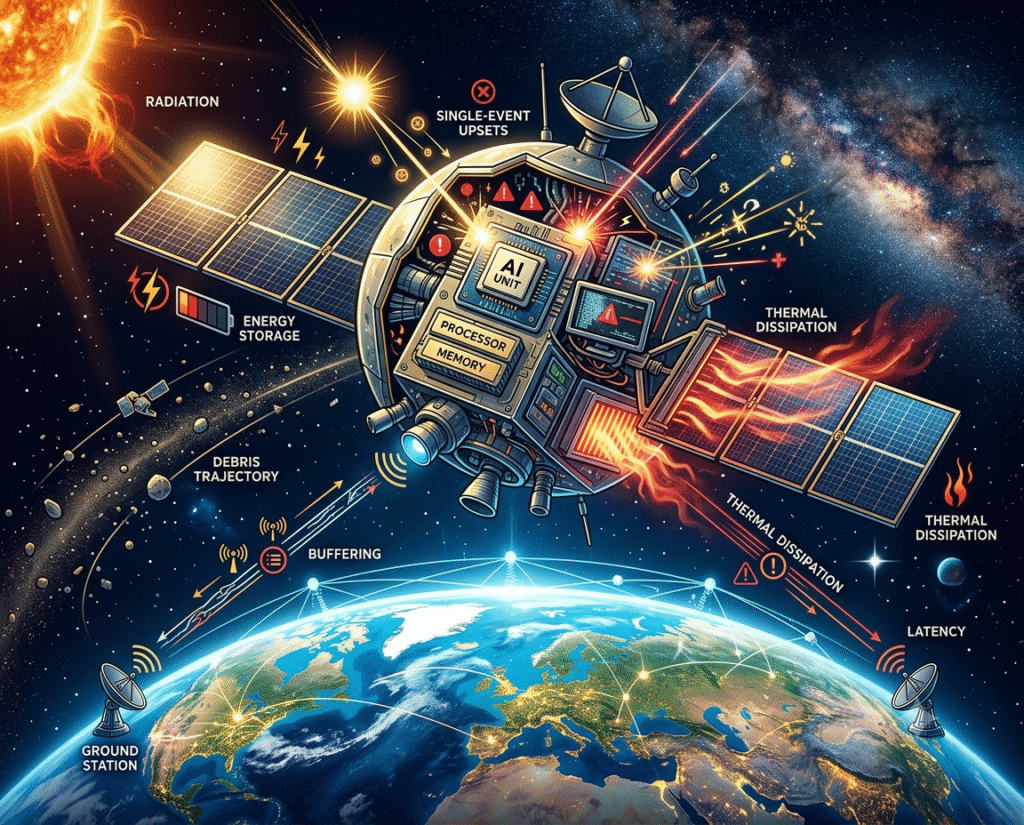
Despite its potential, space-based computing faces significant challenges. Launching equipment into orbit remains expensive, and hardware must be designed to survive the harsh space environment.
Radiation is another major concern. Computing equipment in space may require specialized protection to reduce the effects of radiation. Maintenance is also more complicated because repairing hardware in orbit can be difficult and costly.
Thermal management is another important challenge. While space is extremely cold, removing heat from electronic equipment can be complicated because there is no conventional atmosphere for traditional cooling methods.
These technical and economic challenges must be solved before large-scale orbital data centers become practical.
SpaceX and the Future of Orbital Computing
SpaceX has already developed significant experience in satellite communications, reusable rockets, and large-scale space infrastructure. These capabilities could potentially provide a foundation for future orbital computing projects.
The combination of launch technology and satellite networks could make it easier to deploy and connect computing hardware in orbit. As launch costs decrease and space infrastructure becomes more advanced, the concept of orbital data centers may become more realistic.
However, the development of such systems would require advances in computing hardware, energy systems, communications, and space logistics.
Could Starlink Become More Than an Internet Network?
The future development of Starlink data centers could potentially extend beyond traditional internet connectivity. A large satellite network could eventually become part of a broader space-based digital infrastructure.
Satellites could provide communication, data processing, AI services, and other capabilities. Instead of viewing satellites only as communication platforms, future systems could treat them as distributed nodes in a global computing network.
This could create new possibilities for industries such as telecommunications, defense, scientific research, climate monitoring, and commercial technology.
The Future of Orbital Computing
The future of orbital computing is still in its early stages, but the concept is gaining attention as AI demand continues to grow. Future systems could combine solar-powered satellites, advanced processors, optical communication links, and AI software.
Over time, orbital computing could evolve from small experimental systems into larger networks capable of processing significant amounts of data. The development of reusable launch vehicles could also make it easier to deploy and upgrade hardware in space.
However, widespread adoption will depend on cost, reliability, energy efficiency, and the ability to safely manage space infrastructure.
Conclusion
SpaceX orbital data centers represent one of the most ambitious ideas in the future of technology. By combining satellite networks, advanced computing, and artificial intelligence, space-based infrastructure could potentially transform how data is processed and delivered.
The development of Starlink data centers could eventually create new opportunities for satellite-based computing, while space-based AI computing could help process information closer to where it is generated. Although significant technical and financial challenges remain, the future of orbital computing could become an important part of the next generation of digital infrastructure.
As AI continues to expand, the need for computing power will also increase. In the long term, some of the world’s most advanced computing systems may not operate only on Earth—they could also be located thousands of miles above it.
Frequently Asked Questions
What are SpaceX orbital data centers?
SpaceX orbital data centers refer to the concept of placing computing infrastructure in space to process data and support applications such as artificial intelligence and satellite communications.
What are Starlink data centers?
Starlink data centers refer to the potential development of advanced computing capabilities connected to or integrated with satellite networks. The concept could allow satellites to process data in orbit.
What is space-based AI computing?
Space-based AI computing involves using computing systems located in space to process data, run artificial intelligence applications, and analyze information collected by satellites.
What is the future of orbital computing?
The future of orbital computing could include networks of satellites equipped with advanced processors, solar power systems, and high-speed communication technologies.
Could AI data centers really operate in space?
Potentially, yes. However, significant challenges involving launch costs, radiation protection, cooling, maintenance, and hardware reliability must be addressed before large-scale orbital AI data centers become widely practical.