
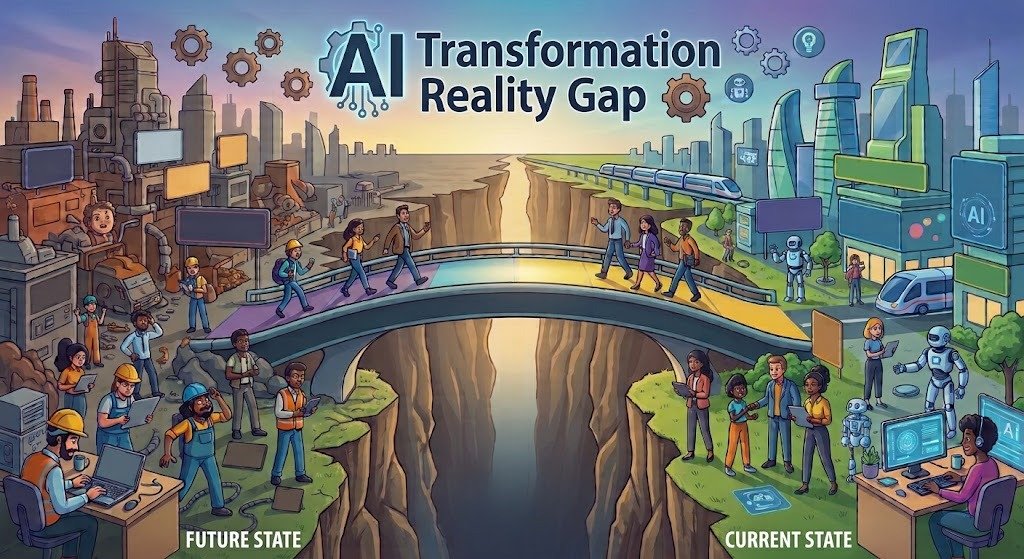

Artificial intelligence has become one of the most influential technologies in modern business. Organizations across industries are investing in AI-powered tools to improve productivity, automate repetitive tasks, enhance customer experiences, and make better decisions. However, despite the growing interest in artificial intelligence, many businesses are discovering that adopting AI does not automatically lead to meaningful results.
This difference between AI expectations and actual business outcomes is known as the AI Transformation Reality Gap. Companies may successfully introduce AI tools but still struggle to achieve measurable improvements in efficiency, revenue, or customer satisfaction.
In 2026, understanding this gap is becoming increasingly important for organizations that want to remain competitive. Businesses need more than advanced technology. They require clear strategies, reliable data, skilled employees, and effective implementation processes.
This article explores the AI transformation reality gap, its major challenges, emerging trends, and practical solutions that can help organizations turn AI investments into real business value.
What Is the AI Transformation Reality Gap?
The AI transformation reality gap refers to the difference between what organizations expect artificial intelligence to accomplish and the results they actually achieve.
Many businesses believe that implementing AI will immediately improve operations, reduce costs, and increase productivity. However, real-world implementation often involves technical limitations, organizational resistance, data problems, and unexpected expenses.
For example, a company may introduce an AI chatbot to improve customer service. Although the chatbot can answer basic questions, it may struggle with complicated requests, misunderstand customer intent, or provide inaccurate information.
As a result, employees may still need to handle most customer interactions manually.
This situation demonstrates that adopting AI technology is only one part of successful transformation. Organizations must also redesign workflows, train employees, and establish clear performance goals.
Why the AI Transformation Reality Gap Is Growing in 2026
Several factors are contributing to the growing difference between AI expectations and business outcomes.
1. Rapid AI Adoption Without Clear Strategies
Businesses are adopting AI technologies at an increasingly rapid pace. However, some organizations introduce AI tools simply because competitors are using them.
Without a clear understanding of business requirements, companies may invest in technologies that do not address their most important problems.
For example, a business might purchase an advanced AI automation platform without identifying which tasks should be automated or how success will be measured.
This can result in unnecessary spending and limited improvements.
Successful AI transformation requires organizations to identify specific business challenges before selecting technological solutions.
2. Data Quality and Integration Challenges
Artificial intelligence depends heavily on data. If an organization uses incomplete, outdated, or inconsistent information, its AI systems may produce unreliable results.
Many businesses also operate with disconnected software systems, making it difficult to provide AI tools with accurate and relevant information.
For instance, an AI-powered sales assistant may struggle to generate useful recommendations if customer records are scattered across multiple platforms.
Improving data quality, accessibility, and integration is therefore essential for achieving reliable AI outcomes.
3. Employee Resistance and Skills Gaps
AI transformation is not only a technological challenge. It also involves people and organizational culture.
Some employees may worry that AI will replace their jobs, while others may lack the skills needed to work effectively with AI-powered systems.
These concerns can create resistance and reduce the effectiveness of new technologies.
Organizations need to provide practical training, communicate the purpose of AI adoption, and help employees understand how AI can support their work.
When employees feel confident using AI tools, they are more likely to contribute to successful transformation.
Major AI Transformation Trends in 2026
Artificial intelligence continues to evolve, and several trends are influencing how organizations approach digital transformation.
1. The Shift from AI Experiments to Practical Implementation
In previous years, many businesses focused on experimenting with AI tools and testing different applications. In 2026, organizations are increasingly interested in turning these experiments into practical business solutions.
Companies are focusing on applications that can improve customer support, automate administrative tasks, analyze business information, and support decision-making.
The emphasis is moving from simply testing AI technology toward understanding its measurable business impact.
2. Growing Interest in AI Agents
AI agents are becoming an important part of enterprise AI strategies. Unlike traditional AI tools that respond to individual prompts, AI agents can perform multiple steps toward a defined objective, depending on their capabilities and permissions.
For example, an AI agent may help organize customer information, prepare reports, or support business workflows.
However, organizations must establish appropriate controls, monitoring systems, and human oversight before using AI agents for important business operations.
3. Increased Focus on Responsible AI
As AI becomes more integrated into business operations, organizations are paying greater attention to data privacy, security, transparency, and accountability.
Businesses need to understand how their AI systems process information and how automated decisions affect customers and employees.
Responsible AI practices can help reduce risks while building trust among stakeholders.
4. Measuring AI Business Value
Another important trend is the growing emphasis on measuring AI performance through meaningful business indicators.
Organizations are evaluating AI projects based on factors such as productivity improvements, operational costs, customer satisfaction, and process efficiency.
This approach helps businesses determine whether their AI investments are delivering practical benefits rather than simply increasing technology adoption.
Practical Solutions to Bridge the AI Transformation Reality Gap
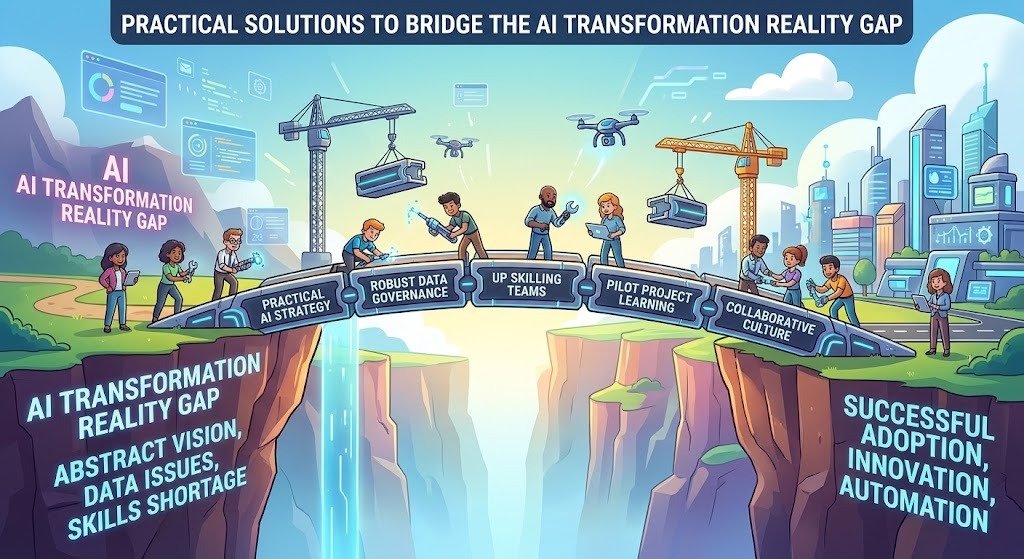
Businesses can reduce the AI transformation reality gap by following a structured approach to implementation.
1. Define Clear Business Objectives
Before implementing AI, organizations should identify the specific problems they want to solve.
For example, a company may want to reduce customer support response times, improve inventory forecasting, or automate repetitive administrative tasks.
Clearly defined objectives make it easier to select appropriate AI tools and evaluate their performance.
2. Start with Small, Measurable Projects
Instead of transforming every department simultaneously, businesses can begin with a limited AI project.
A small pilot project allows organizations to test technology, identify limitations, and gather feedback before expanding implementation.
For example, a company could introduce an AI assistant to support one customer service team before deploying it across the entire organization.
This approach can reduce implementation risks and provide valuable insights.
3. Invest in Employee Training
Employees need practical knowledge to use AI tools effectively.
Organizations should provide training programs that explain how AI works, how to create effective prompts, how to review AI-generated information, and how to identify potential mistakes.
Training should also emphasize that AI can support human decision-making rather than automatically replacing professional judgment.
A workforce that understands AI is more likely to adopt new technologies successfully.
4. Improve Data Infrastructure
Businesses should establish reliable data management practices before expanding their AI systems.
This includes improving data quality, removing unnecessary duplication, organizing information, and ensuring that AI tools can access appropriate data securely.
A strong data foundation can improve the reliability of AI-generated insights and reduce the likelihood of inaccurate results.
5. Establish Governance and Human Oversight
AI systems should operate within clear organizational policies.
Businesses need to define who is responsible for AI-generated decisions, how sensitive information is protected, and when human approval is required.
Human oversight is particularly important for decisions involving financial transactions, customer information, employee evaluations, or other sensitive business activities.
Effective governance helps organizations balance innovation with accountability.
How Businesses Can Measure AI Transformation Success
Measuring AI performance is essential for understanding whether a project is delivering value.
Organizations can evaluate AI initiatives using several key performance indicators.
| KPI | What It Measures |
| Productivity | Improvement in employee output |
| Cost Reduction | Changes in operational expenses |
| Customer Satisfaction | Quality of customer experience |
| Process Efficiency | Time required to complete tasks |
| Accuracy | Reliability of AI-generated results |
| Return on Investment | Financial value compared with AI implementation costs |
Businesses should establish a baseline before introducing AI. This allows them to compare performance before and after implementation.
For example, if an AI-powered system reduces the time required to prepare reports, the organization can calculate the productivity improvement and determine whether the investment is worthwhile.
It is also important to consider indirect costs, including employee training, software integration, maintenance, and ongoing monitoring.
The Future of AI Transformation Beyond 2026
The future of AI transformation will depend on how effectively organizations combine technology with business strategy.
AI systems are expected to become increasingly integrated into everyday business operations. Organizations may use AI to support planning, automate complex workflows, improve customer interactions, and analyze large volumes of information.
However, successful transformation will continue to require strong leadership, reliable data, employee participation, and responsible technology management.
Businesses that focus on practical outcomes rather than AI hype will be better positioned to create sustainable value.
The AI transformation reality gap is unlikely to disappear completely. New technologies will introduce new opportunities as well as new challenges. Organizations that continuously evaluate their AI strategies and adapt to changing requirements can improve their ability to achieve meaningful results.
Frequently Asked Questions (FAQs)
1. What is the AI transformation reality gap?
The AI transformation reality gap is the difference between the expected benefits of artificial intelligence and the actual results achieved by an organization.
2. Why do businesses struggle with AI transformation?
Businesses may struggle because of poor data quality, unclear objectives, employee resistance, technical integration problems, and unrealistic expectations.
3. What are the major AI transformation trends in 2026?
Major trends include practical AI implementation, AI agents, responsible AI governance, workflow automation, and increased focus on measurable business value.
4. How can companies overcome the AI transformation reality gap?
Organizations can overcome the gap by defining clear objectives, starting with small projects, improving data infrastructure, training employees, and measuring AI performance.
5. Is AI transformation important for businesses?
Yes. AI transformation can help businesses improve productivity, automate repetitive work, enhance decision-making, and create better customer experiences when implemented effectively.
Conclusion
The AI transformation reality gap highlights an important challenge facing modern organizations. Although artificial intelligence offers significant opportunities, adopting new technology does not automatically guarantee business success.
Companies must understand their objectives, improve data quality, prepare employees, and establish responsible AI practices. They should also measure performance carefully to determine whether their investments are producing meaningful results.
In 2026, successful AI transformation is not simply about using the latest AI tools. It is about integrating artificial intelligence into business operations in a way that creates measurable value.
Organizations that focus on practical implementation, continuous improvement, and human collaboration can reduce the AI transformation reality gap and build a stronger foundation for long-term growth.