
Introduction
Agriculture is changing as farmers adopt new technologies to improve productivity, manage resources, and respond to environmental challenges. From smart sensors to automated machinery, modern farming increasingly depends on digital tools that help farmers make better decisions. One emerging technology attracting attention is Agentic AI in agriculture.
Unlike traditional software that follows fixed instructions, Agentic AI systems can work toward specific goals, analyze information, plan actions, and complete certain tasks with limited human intervention. In farming, these capabilities could help monitor crop conditions, manage irrigation, identify potential problems, and support everyday farm operations.
As agricultural businesses face challenges such as unpredictable weather, rising costs, water shortages, and changing crop demands, intelligent automation offers new opportunities. This article explores how Agentic AI is transforming smart farming, its major applications, benefits, challenges, and future potential.
What Is Agentic AI in Agriculture?
Agentic AI refers to artificial intelligence systems designed to pursue goals through a series of actions. These systems can analyze information, make decisions, use available tools, and adjust their approach based on new information.
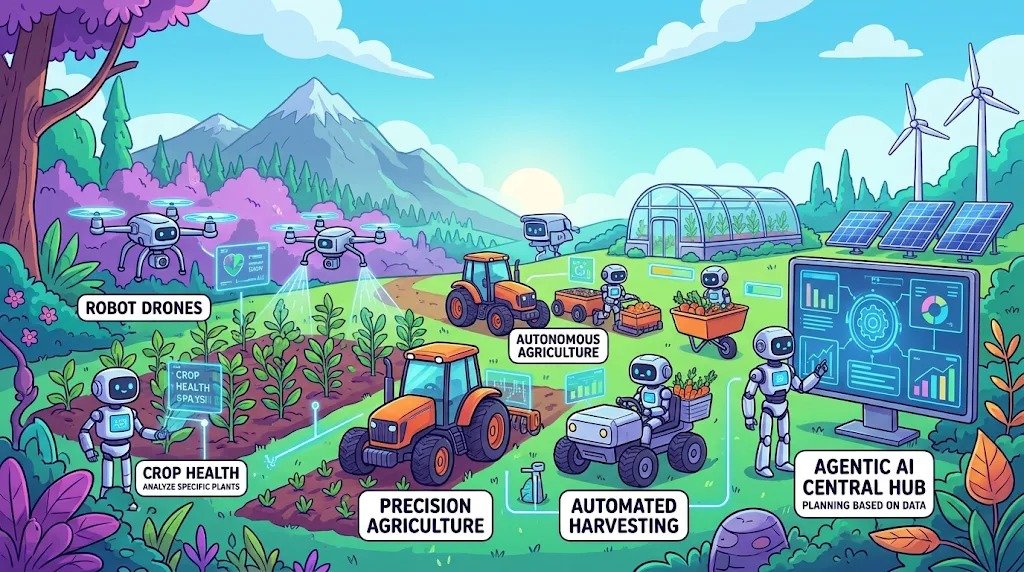
In agriculture, Agentic AI can connect different sources of farm data, including soil sensors, weather forecasts, satellite images, crop monitoring systems, and agricultural equipment.
For example, an AI agent monitoring a field might detect that soil moisture is falling below a preferred level. It could analyze weather forecasts, check irrigation conditions, and recommend or initiate an irrigation action if it has the necessary permissions.
The important difference is that Agentic AI is not limited to producing a prediction or answering a question. It can potentially coordinate multiple steps to achieve a farming objective.
However, the level of autonomy depends on the system’s design. Some tools only recommend actions, while others can carry out approved tasks automatically.
How Agentic AI Is Transforming Smart Farming
1. Intelligent Crop Monitoring
Crop monitoring is one of the most promising applications of Agentic AI in agriculture.
Farmers need to understand how crops are developing throughout the growing season. Traditional monitoring may require frequent field visits and manual inspections, which can be time-consuming, particularly across large farms.
Agentic AI systems can analyze information from drones, satellite imagery, cameras, and field sensors. They may identify unusual crop patterns, detect changes in plant growth, and highlight areas that require attention.
For example, an AI agent could identify a section of a field showing signs of poor crop development. It could compare the information with soil conditions and recent weather data before recommending further inspection.
This allows farmers to focus their attention on areas where intervention may be needed.
2. Smarter Irrigation Management
Water management is essential for successful farming. Too little water can affect crop growth, while excessive irrigation may waste resources and damage soil conditions.
Agentic AI can help improve irrigation planning by analyzing soil moisture, temperature, rainfall forecasts, and crop requirements.
An AI agent may monitor moisture levels and recommend when irrigation is needed. In systems connected to automated irrigation equipment, it may also activate approved watering schedules.
For example, if rainfall is expected soon, the system could recommend delaying irrigation to avoid unnecessary water use.
These decisions can help farmers manage water more efficiently, although local conditions and crop-specific requirements still need to be considered.
3. Early Pest and Disease Detection
Pests and plant diseases can cause significant agricultural losses if they are not identified quickly.
Agentic AI systems can analyze images of crops and compare visible symptoms with available agricultural information. They may help identify unusual leaf patterns, discoloration, or other warning signs.
After detecting a possible issue, an AI agent could gather relevant weather information, identify affected field areas, and recommend that farmers inspect the crops more closely.
Some advanced workflows may also connect detection systems with farm management tools to organize follow-up actions.
However, AI detection should not always be treated as a final diagnosis. Farmers and agricultural specialists may need to verify the problem before applying pesticides or other treatments.
4. Precision Farming and Resource Management
Precision farming focuses on using the right resources in the right locations and at the right time.
Agentic AI can support this approach by analyzing information from different farm systems. It may help identify where fertilizers, water, or other resources are needed.
Instead of applying the same treatment across an entire field, farmers may use AI-generated recommendations to manage different areas according to their specific conditions.
This approach can help reduce unnecessary resource use and improve farm planning.
The results depend on the quality of available data, equipment compatibility, and the accuracy of the recommendations.
5. Automated Farm Operations
Modern farms use machinery for planting, spraying, harvesting, transportation, and other activities.
Agentic AI can help coordinate certain operations by analyzing schedules, equipment availability, weather conditions, and field requirements.
For example, an AI agent might recommend adjusting a planting schedule because rain is expected. In a connected farm system, it could also help organize equipment tasks and notify operators about potential delays.
When combined with robotics and autonomous agricultural machinery, Agentic AI may support more coordinated farm operations.
Human supervision remains important, particularly when machinery operates near workers, animals, or public areas.
Major Benefits of Agentic AI in Agriculture
Agentic AI can offer several advantages for modern farming.
Improved decision-making: AI agents can analyze large amounts of agricultural information and help farmers make more informed decisions.
Time savings: Automated monitoring and task coordination can reduce the need for some repetitive manual activities.
Better resource management: Intelligent systems may help farmers use water, fertilizers, and other resources more efficiently.
Early problem identification: Continuous data analysis can help highlight possible crop problems before they become more serious.
Operational efficiency: AI-assisted scheduling and coordination can improve how farm activities are organized.
Scalable monitoring: Digital systems can help monitor large agricultural areas that may be difficult to inspect manually.
These benefits are not guaranteed. They depend on the technology, farming environment, data quality, and the way farmers implement the system.
Challenges of Using Agentic AI in Agriculture
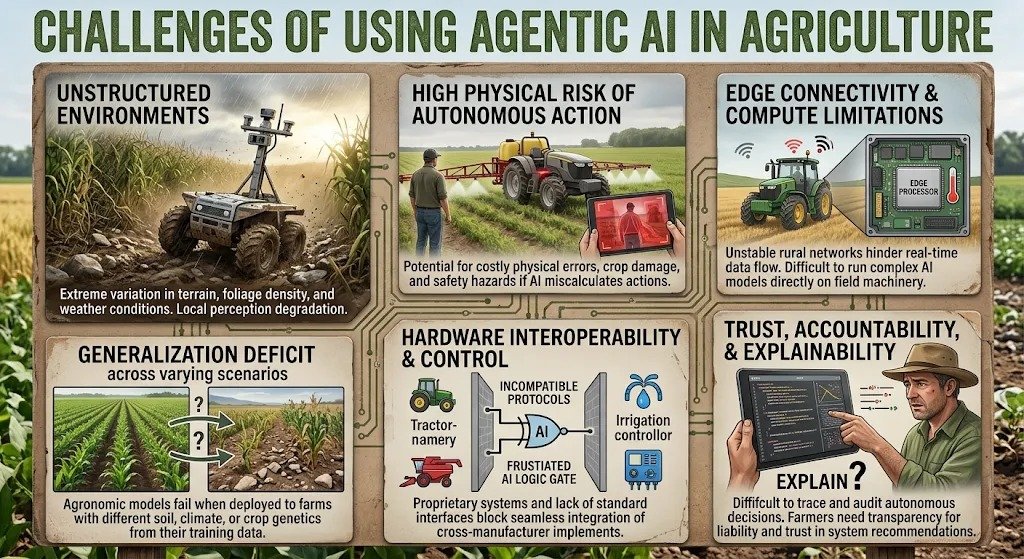
Although Agentic AI offers exciting possibilities, its adoption also comes with challenges.
1. High Initial Costs
Some AI-powered agricultural systems require sensors, connected machinery, drones, software subscriptions, and reliable communication infrastructure.
These expenses may be difficult for small farms to manage. Affordable solutions and shared technology services could help make adoption easier.
2. Data Quality and Accuracy
AI systems depend on accurate and relevant information. Incorrect sensor readings, incomplete field records, or outdated weather data can lead to poor recommendations.
Farmers need reliable data collection methods and regular system checks to maintain performance.
3. Internet and Connectivity Limitations
Many rural areas have limited internet access. This can make it difficult for cloud-based AI systems to receive information or communicate with agricultural equipment.
Offline capabilities and local processing may help address some connectivity problems.
4. Human Oversight and Safety
Agentic AI systems may be able to perform actions automatically, but not every agricultural decision should be made without human review.
Actions involving pesticides, expensive machinery, or critical crop management decisions may require approval from farmers or agricultural specialists.
5. Skills and Training
Farmers may need training to understand AI recommendations, configure digital systems, and manage automated equipment.
Technology providers should make their tools accessible and provide practical support to users with different levels of technical experience.
The Future of Agentic AI in Agriculture
The future of Agentic AI in agriculture will likely involve greater integration between artificial intelligence, robotics, sensors, and farm management platforms.
AI agents may become better at coordinating activities across entire farming operations. Instead of managing irrigation, crop monitoring, and equipment schedules separately, connected systems could work together toward broader farm objectives.
Advances in machine learning and computer vision may also improve crop analysis and environmental monitoring.
In addition, agricultural robots and autonomous machines could perform more specialized tasks under human supervision.
However, successful adoption will require affordable technology, reliable data, strong cybersecurity, and clear safety procedures. Farmers will continue to play an essential role by providing practical knowledge and overseeing important decisions.
Frequently Asked Questions
What is Agentic AI in agriculture?
Agentic AI in agriculture refers to AI systems that can analyze farm information, plan actions, and perform certain tasks to achieve agricultural goals, often with limited human intervention.
How can Agentic AI help farmers?
It can support crop monitoring, irrigation planning, pest detection, resource management, and the coordination of farm operations.
Is Agentic AI different from traditional AI?
Yes. Traditional AI tools often focus on specific tasks, such as predicting crop conditions or classifying images. Agentic AI can potentially combine multiple steps, use tools, and take actions toward a defined goal.
Can Agentic AI reduce farming costs?
It may help reduce unnecessary resource use, improve planning, and save time. However, initial technology costs and ongoing maintenance must also be considered.
Will Agentic AI replace farmers?
No. Agentic AI is better understood as a tool that can support agricultural work. Farmers still provide essential knowledge, judgment, supervision, and decision-making.
Conclusion
Agentic AI in agriculture represents an important development in the evolution of smart farming. By combining data analysis, planning, automation, and intelligent decision-making, AI agents can help farmers monitor crops, manage irrigation, identify potential problems, and coordinate agricultural operations.
Although challenges such as cost, connectivity, data quality, and safety remain, the technology offers opportunities to make farming more efficient and responsive.
As AI and agricultural robotics continue to advance, Agentic AI may become an increasingly valuable tool for modern farms. The most successful approach will combine intelligent automation with farmers’ experience, practical knowledge, and human oversight.