
Introduction
The workplace is becoming increasingly digital, and businesses are looking for smarter ways to manage employees, reduce administrative work, and improve the overall employee experience. How AI Agents in HRMS Improve Employee Management and HR Automation is an important topic as organizations increasingly adopt artificial intelligence to streamline everyday human resource activities. Modern HR technology can help HR teams manage employee information, answer routine questions, automate workflows, and analyze workforce data. By combining AI agents with automated HR processes and intelligent HR software, businesses can reduce repetitive tasks while giving HR professionals more time to focus on strategic workforce planning and employee development.
How AI Agents in HRMS Improve Employee Management and HR Automation
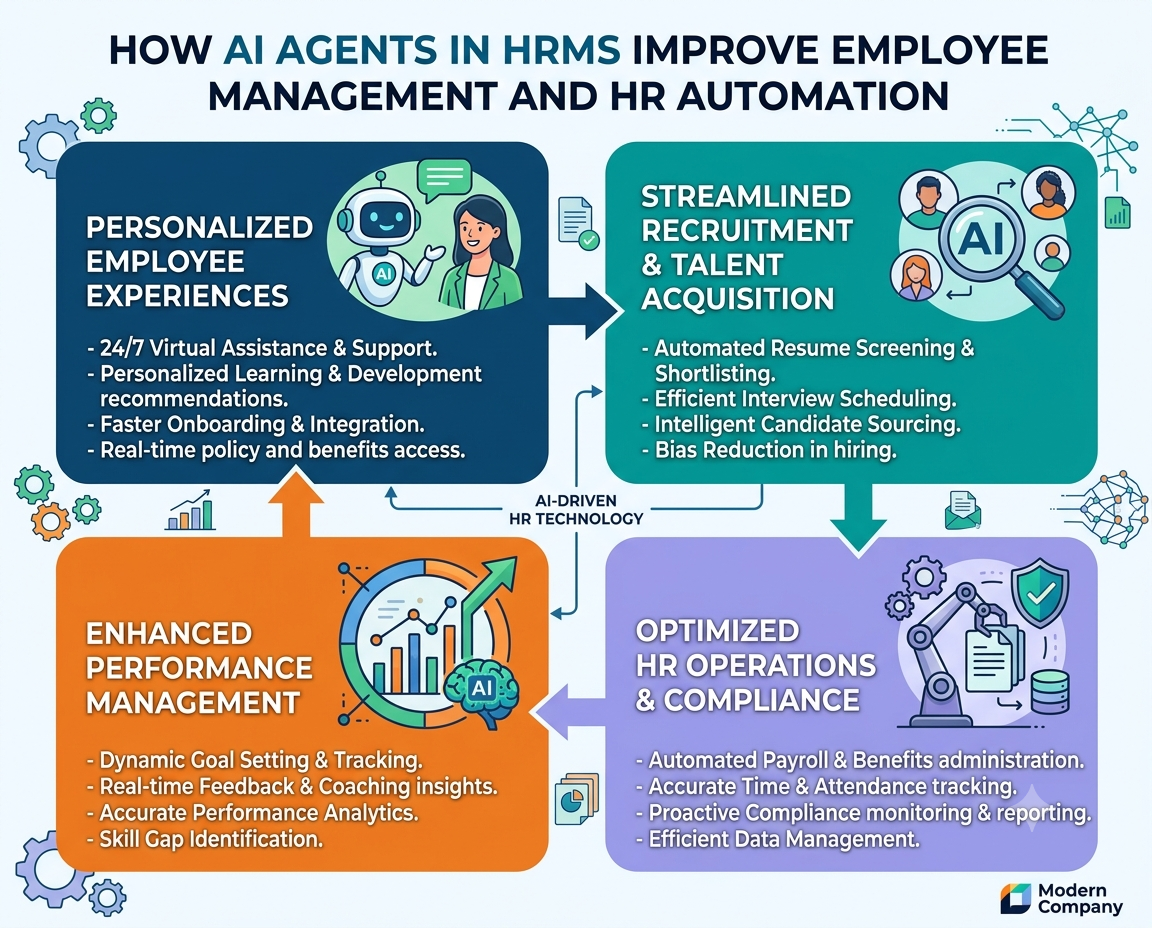
AI agents are intelligent software systems that can perform specific tasks, analyze information, respond to requests, and support employees with limited human intervention. When integrated into an HRMS, these agents can become valuable assistants for HR departments and employees.
Unlike basic automation that simply follows fixed instructions, AI agents can analyze information and respond according to context. This makes them useful for employee support, recruitment, onboarding, attendance management, and other HR functions.
What Are AI Agents in HRMS?
An HRMS, or Human Resource Management System, stores and manages important employee information and HR processes. AI agents add an intelligent layer to these systems by helping users interact with HR information and complete routine tasks.
For example, an employee may ask an AI agent about vacation policies, payroll dates, benefits, or company procedures. Instead of waiting for an HR representative, the employee can receive an immediate response through the HR platform.
This creates a faster and more convenient employee experience.
The Role of HR Technology
Modern HR technology is changing the way organizations manage their workforce. Traditional HR departments often spend significant amounts of time handling repetitive administrative tasks such as updating records, responding to common questions, tracking attendance, and processing requests.
AI-powered HR systems can automate many of these activities.
Businesses can use AI agents to:
- Answer employee questions
- Manage HR requests
- Assist with onboarding
- Organize employee information
- Support recruitment workflows
- Generate workforce reports
- Track important HR tasks
The result is a more efficient HR environment with fewer manual processes.
Automated HR Processes
One of the biggest advantages of AI agents is their ability to support automated HR processes. Automation can reduce the amount of repetitive work performed manually by HR teams.
For example, when a new employee joins a company, an AI-powered HRMS can help initiate onboarding tasks, provide required documents, explain company policies, and remind employees about incomplete steps.
Similarly, employees can submit leave requests, update certain information, or ask routine questions without requiring direct HR intervention for every request.
Employee Self-Service
Employee self-service is another important application of AI in HRMS platforms.
Employees can interact with AI agents to find information about:
- Leave balances
- Benefits
- Company policies
- Payroll information
- Attendance
- Onboarding requirements
- Workplace procedures
This reduces unnecessary communication delays and allows employees to access information when they need it.
HR professionals also benefit because they can spend less time answering repetitive questions.
Intelligent HR Software
Modern intelligent HR software can analyze workforce information and provide useful insights to HR managers.
AI systems may help identify patterns involving employee engagement, attendance, recruitment, turnover, and workforce requirements.
For example, an HR team could use data analysis to identify departments experiencing increased turnover or determine which recruitment channels are producing stronger candidates.
These insights can support better workforce planning and decision-making.
AI Agents in Recruitment
Recruitment is another area where AI agents can improve HR operations.
AI-powered HRMS platforms can assist with:
- Candidate screening
- Interview scheduling
- Job description creation
- Candidate communication
- Application tracking
- Recruitment analytics
AI agents can handle many repetitive recruitment tasks while recruiters focus on evaluating candidates and making final hiring decisions.
Human oversight remains important because recruitment decisions can affect people’s careers and should not rely solely on automated systems.

Employee Onboarding
A smooth onboarding experience can help new employees become productive more quickly.
AI agents can guide new employees through onboarding by providing instructions, answering questions, sending reminders, and helping them navigate HR systems.
For example, an AI assistant could remind a new employee to complete required documents or explain how to access company benefits.
This creates a more consistent onboarding experience across the organization.
Performance and Employee Management
AI agents can also support ongoing employee management.
HR teams can use intelligent systems to organize performance information, schedule reviews, track development goals, and provide managers with relevant workforce insights.
AI should support—not replace—human judgment in performance management. Managers still need to consider context, individual circumstances, and direct interactions with employees before making important decisions.
Benefits of AI Agents in HRMS
Businesses can gain several advantages from integrating AI agents into HR systems.
Increased Efficiency
Automation reduces repetitive administrative work and allows HR teams to focus on strategic activities.
Faster Employee Support
Employees can receive answers to common questions quickly instead of waiting for an HR representative.
Improved Data Access
AI systems can make large amounts of HR information easier to search and understand.
Better Workforce Insights
AI-powered analytics can help organizations identify patterns and make more informed workforce decisions.
Consistent HR Processes
Automated workflows can help organizations maintain consistent procedures across departments and locations.
Data Security and Privacy
HR systems contain sensitive employee information, so security must be a major consideration when implementing AI.
Organizations should use appropriate access controls, encryption, authentication, monitoring, and data governance practices.
Companies should also clearly understand how employee data is collected, processed, stored, and used by AI systems.
Transparency is especially important when AI is involved in recruitment, performance analysis, or other decisions that may significantly affect employees.
Challenges of AI Agents in HRMS
Although AI provides significant benefits, implementation can present challenges.
Businesses may need to address:
- Data quality
- Employee privacy
- Integration with existing systems
- AI accuracy
- Employee acceptance
- Cybersecurity
- Regulatory requirements
- Human oversight
AI systems are only as effective as the information and processes supporting them. Organizations should therefore introduce AI carefully and continuously evaluate its performance.
The Future of AI in HRMS
The future of HR technology will likely involve increasingly intelligent systems that can handle more complex workflows while working alongside HR professionals.
Future AI agents may become better at understanding employee requests, analyzing workforce trends, supporting personalized learning, and coordinating complex HR processes.
However, successful adoption will depend on maintaining a balance between automation and human interaction. HR is ultimately about people, so technology should enhance human decision-making rather than eliminate the human element.
Conclusion
How AI Agents in HRMS Improve Employee Management and HR Automation demonstrates how artificial intelligence can transform modern human resource operations. By combining HR technology, automated HR processes, and intelligent HR software, businesses can reduce repetitive administrative work, improve employee self-service, streamline recruitment and onboarding, and gain valuable workforce insights. AI agents can make HR operations faster and more accessible, but organizations must also prioritize privacy, security, transparency, and human oversight. As AI continues to evolve, HRMS platforms are likely to become increasingly intelligent, helping businesses create more efficient and employee-focused workplaces.
Frequently Asked Questions
What are AI agents in HRMS?
AI agents in HRMS are intelligent software assistants that can answer questions, automate tasks, analyze information, and support employees and HR teams within a human resource management system.
How does AI improve HR automation?
AI supports automated HR processes by handling repetitive activities such as employee inquiries, onboarding tasks, scheduling, document management, and certain administrative workflows.
What is intelligent HR software?
Intelligent HR software uses technologies such as artificial intelligence, machine learning, automation, and analytics to improve human resource management and workforce decision-making.
Can AI agents replace HR professionals?
AI agents are primarily designed to support HR professionals by reducing repetitive work and providing information. Important decisions involving employees should continue to include appropriate human judgment and oversight.
Is AI in HRMS secure?
AI-powered HRMS platforms can be secure when organizations implement strong access controls, authentication, encryption, data governance, monitoring, and appropriate privacy practices.
Why is HR technology important for modern businesses?
HR technology helps organizations manage employee information, automate administrative work, improve communication, analyze workforce data, and create more efficient HR operations.