
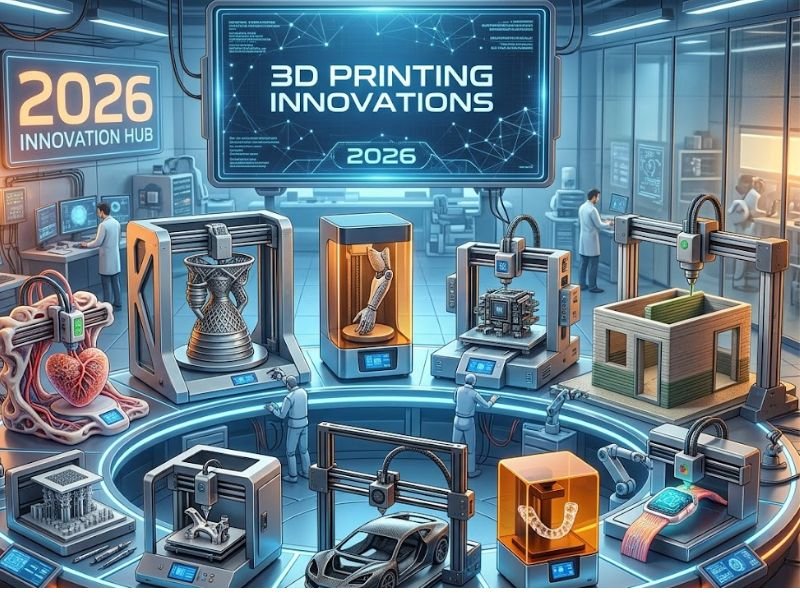

3D printing innovations in 2026 are moving faster than almost any other corner of manufacturing technology, and the shift is impossible to ignore whether you are a hobbyist, an engineer, or a business owner exploring new production methods. Just two years ago, most of the excitement in this space was about raw print speed. Today, the conversation has widened into something much bigger:
artificial intelligence that designs objects on its own, printers safe enough for a child’s bedroom, filaments made from recycled waste, and metal printing techniques once locked away in aerospace labs. Some of these breakthroughs are already available to buy, while others are still being refined in research labs but close enough to matter this year. Below is a practical, grounded look at the ten 3D printing innovations in 2026 that are genuinely reshaping how things get designed, made, and delivered.
1. AI-Generative Design Takes Over
The single biggest change driving 3D printing innovations in 2026 is artificial intelligence. AI has stopped being a marketing buzzword and has become a real design partner. Instead of manually modeling every part in CAD software, users can now describe what they need in plain language, and AI tools generate print-ready files within minutes. This lowers the skill barrier dramatically, allowing beginners to create functional, optimized designs that once required years of engineering experience. Slicers are also becoming smarter, automatically adjusting supports, infill, and print settings based on the geometry of the object, which reduces failed prints and wasted material.
2. Bioprinting Reaches Clinical Applications
Bioprinting is one of the most exciting 3D printing innovations in 2026, moving from research labs into real clinical use. Scientists are now successfully printing complex vascular networks and tissue structures using bio-inks made from living cells, solving one of the field’s toughest problems: keeping printed tissue alive by supplying it with blood vessels. Hospitals are increasingly using this technology for patient-specific implants, prosthetics, and surgical planning models, while early clinical trials for lab-grown tissue are already underway. This progress is expected to reshape regenerative medicine over the next few years.
3. Large-Scale Additive Construction (LSAC) in Housing
Construction is being reshaped by one of the most visible 3D printing innovations in 2026: large-scale additive construction, or LSAC. Massive printers are now capable of extruding entire concrete walls and building shells within days rather than weeks. This approach is being used to address housing shortages, cut labor costs, and reduce construction waste, particularly in disaster relief and affordable housing projects. Cities around the world are experimenting with printed homes as a faster, cheaper alternative to traditional construction methods.
4. Faster, Smarter FDM Printers
Print speed has taken another major leap forward. Consumer-grade FDM printers now reach speeds of 500 to 600 millimeters per second, a number that would have seemed unrealistic just five years ago when 60 mm/s was considered fast. This jump is possible thanks to CoreXY mechanics, servo-driven extrusion, and vibration compensation software that keeps prints accurate even at high acceleration. The bottleneck in 3D printing is no longer the machine it is now the operator, meaning workflow and design skills matter more than ever.
5. Multi-Material and Multi-Color Printing Goes Mainstream
Among the most practical 3D printing innovations in 2026 is the rise of true multi-material printing. Printers can now combine soft and rigid materials, or multiple colors, within a single job without manual intervention. Companies are introducing nozzle-swapping systems and upgrade kits that convert single-material printers into multi-material machines. This opens the door to parts that are lighter, stronger, and more functional, such as flexible hinges built directly into rigid housings, without needing separate assembly steps.
6. Sustainable and Recycled Filaments
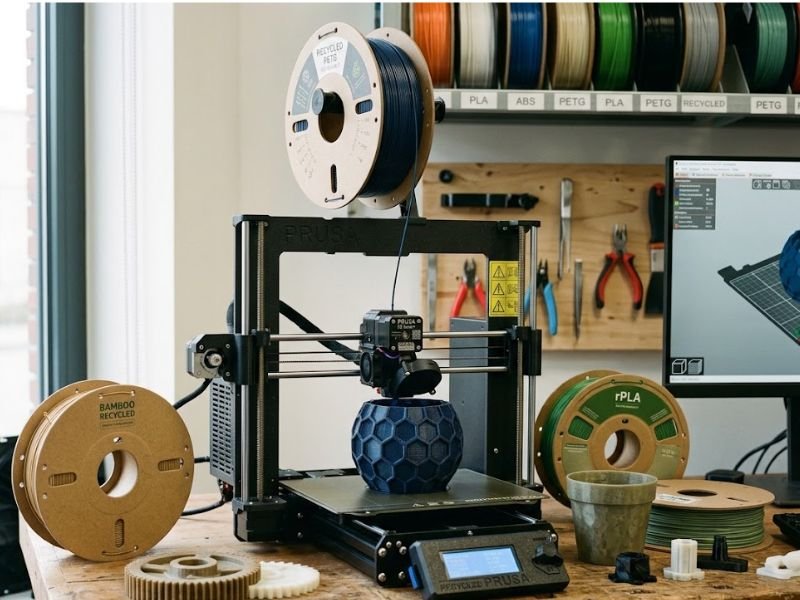
Sustainability has become a core theme across this year’s 3D printing innovations. Recycled filaments, bio-based polymers, and biodegradable plastics are gaining serious traction as manufacturers respond to environmental concerns and circular-economy demands. New waste-reduction systems also minimize filament loss during color changes and failed prints, making the entire process more efficient. For eco-conscious makers and businesses, sustainable materials are quickly becoming the default choice rather than a niche option.
7. Metal 3D Printing Breaks Into New Industries
Metal additive manufacturing continues to be one of the fastest-growing categories of 3D printing innovations in 2026. New green laser systems are expanding the range of metals that can be printed reliably, while post-print sintering techniques are simplifying processes that once required complex laser-melting steps. Industries like aerospace, automotive, and medical devices are adopting metal printing for lightweight, high-strength components that are difficult or impossible to produce with traditional machining.
8. Safer Printers for Home and Family Use
Consumer safety has become a genuine engineering priority. Manufacturers are now designing enclosed, ventilated printers certified safe enough for use around children, addressing long-standing concerns about fumes and moving parts. This shift reflects how 3D printing is transitioning from a niche hobbyist tool into an everyday home appliance, much like a microwave or a sewing machine, making the technology accessible to a much wider audience.
9. Industrial-Grade Reliability for Home Workshops
Features once exclusive to expensive industrial machines are now converging with affordable desktop printers. Built-in multi-color systems, advanced slicer software, and plug-and-play calibration are turning home setups into semi-professional production tools. This “industrialization of the home workshop” is one of the defining 3D printing innovations in 2026, letting small businesses and independent creators manufacture polished, market-ready products without investing in factory-grade equipment.
10. Digital Inventory and On-Demand Manufacturing
Rather than storing physical spare parts, companies are increasingly keeping digital part libraries that can be printed on demand, anywhere in the world. This approach reduces warehousing costs, shortens supply chains, and allows for rapid repairs in industries like aviation and heavy equipment. Combined with AI-driven design and faster printers, on-demand manufacturing is turning 3D printing into a genuine production tool rather than just a prototyping method.
Conclusion
The 3D printing innovations in 2026 show an industry that has matured far beyond its hobbyist roots. From AI-generated designs and bioprinted tissue to sustainable filaments and safer home printers, this year marks a real turning point where multiple bottlenecks in hardware, software, and materials are being solved together. Whether you’re a business exploring on-demand manufacturing or a hobbyist curious about what’s next, understanding these 3D printing innovations in 2026 will help you stay ahead in a rapidly evolving field.
FAQs
Q1. What is the biggest 3D printing innovation in 2026? AI-generative design is widely considered the biggest shift, since it allows anyone to create functional, print-ready models without traditional CAD skills.
Q2. Is 3D printing becoming more affordable in 2026? Yes. Features once limited to expensive industrial machines, such as multi-material printing and advanced calibration, are now appearing in budget-friendly desktop printers.
Q3. How is 3D printing being used in healthcare? Bioprinting is being used to create patient-specific implants, surgical planning models, and lab-grown tissue with functioning vascular networks.
Q4. Are 3D printed houses actually being built? Yes. Large-Scale Additive Construction (LSAC) is already being used to build homes faster and cheaper, especially for affordable housing and disaster relief projects.
Q5. Is 3D printing environmentally friendly? It’s becoming more sustainable thanks to recycled filaments, bio-based materials, and smarter software that reduces material waste during printing.