

Introduction
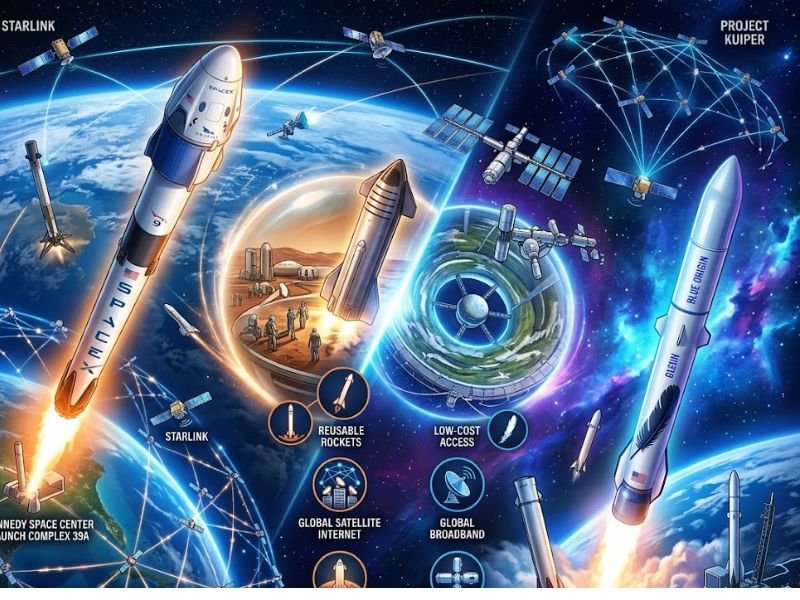
The modern space industry is no longer controlled only by government agencies. Private companies are investing heavily in rockets, satellites, launch systems, and global connectivity. SpaceX vs. Amazon represents one of the most interesting developments in this new era, as both companies are pursuing ambitious goals beyond Earth. While SpaceX has built a strong presence through reusable rockets and Starlink, Amazon is developing Project Kuiper to compete in the growing satellite internet market. This space technology competition could influence how people connect to the internet, how businesses use space-based services, and how the commercial space industry develops in the years ahead.
SpaceX vs. Amazon: Two Different Approaches to Space
The comparison between SpaceX vs. Amazon is not a traditional competition between identical companies. Their backgrounds and strategies are different.
SpaceX was created as a space-focused company and has spent years developing launch systems, reusable rocket technology, spacecraft, and satellite networks. Amazon, on the other hand, is a major technology and commerce company with extensive experience in cloud computing, logistics, consumer technology, and large-scale infrastructure.
Amazon’s Project Kuiper represents its major effort to build a satellite network capable of delivering broadband connectivity.
Although the companies have different histories, both are now connected to one of the most important areas of modern space development: global connectivity.
The Role of Starlink in Satellite Internet
Starlink is one of SpaceX’s most significant projects. The system uses a large network of satellites in low Earth orbit to provide internet connectivity.
Traditional satellite internet has often relied on satellites located much farther from Earth. Low Earth orbit systems can potentially reduce communication delay compared with some traditional satellite architectures.
Starlink has also helped demonstrate that large-scale satellite internet networks can become an important part of global communications infrastructure.
The technology may be particularly useful in areas where traditional broadband infrastructure is difficult or expensive to build.
However, satellite connectivity is not a complete replacement for fiber or other terrestrial networks. Each technology has different advantages depending on location, infrastructure, cost, and user requirements.
Amazon’s Project Kuiper
Project Kuiper is Amazon’s satellite broadband initiative.
The project aims to build a network designed to provide internet access through satellites, expanding connectivity options for consumers, businesses, and communities.
Amazon brings significant infrastructure experience to the project. Its cloud computing capabilities, consumer technology ecosystem, and logistics network could provide useful advantages as it develops satellite services.
The success of Project Kuiper will depend on many factors, including satellite deployment, launch capacity, ground infrastructure, customer equipment, pricing, and service availability.
This is why SpaceX vs. Amazon is becoming an important story in the development of global broadband technology.
Space Technology Competition and Innovation
Competition can encourage companies to improve technology, reduce costs, and develop new solutions.
The current space technology competition between private companies is helping accelerate investment in launch systems, satellite networks, communication infrastructure, and advanced manufacturing.
When companies compete for customers and technological leadership, they have an incentive to improve reliability and efficiency.
For consumers and businesses, increased competition could eventually create more choices in connectivity services.
However, the space industry also involves major technical, financial, and regulatory challenges. Launching and maintaining satellite networks requires significant investment and long-term planning.
Success is not guaranteed simply because a company has strong financial resources.
Rockets and Launch Capabilities
One of the major differences between the two companies is their direct involvement in launch technology.
SpaceX has developed and operated its own launch systems, allowing it to place satellites into orbit using its own rockets.
This vertical integration can provide strategic advantages because launch capability is an important part of building and maintaining a large satellite network.
Amazon has pursued satellite deployment through partnerships and launch agreements rather than relying on an equivalent in-house operational rocket system.
This difference could influence the speed and flexibility with which each company expands its satellite network.
Launch access remains one of the most important elements of the modern commercial space industry.
SpaceX vs. Amazon and the Future of Global Connectivity
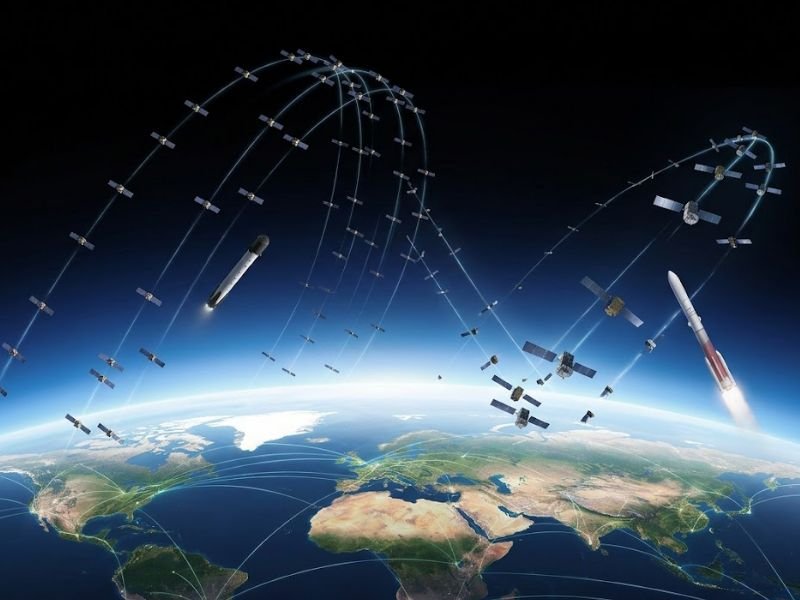
The competition is about more than rockets and satellites. At its core, it is also about global communication.
Billions of people around the world still face challenges related to reliable internet access. Remote areas, rural communities, ships, aircraft, and other difficult-to-connect locations may benefit from additional connectivity options.
Satellite systems can provide coverage in places where building traditional infrastructure may be difficult.
The SpaceX vs. Amazon rivalry could therefore influence how broadband services develop in underserved and remote regions.
The final impact will depend on affordability, service quality, regulatory approval, local infrastructure, and the ability of providers to scale their networks responsibly.
The Commercial Space Industry Is Growing
The commercial space industry has expanded beyond traditional government missions.
Private companies are now involved in satellite communications, Earth observation, launch services, space tourism, research, manufacturing, and infrastructure.
This expansion is creating new opportunities for technology companies, investors, engineers, and service providers.
The growth of commercial activity can also encourage the development of new supply chains and specialized technologies.
Companies competing in space are not only building rockets or satellites. They are creating ecosystems involving software, communications networks, ground stations, user hardware, and data services.
Challenges of Large Satellite Networks
Building large satellite constellations also creates important challenges.
One concern is space congestion. As more satellites are launched, operators need to manage spacecraft carefully and reduce the risk of collisions.
Space debris is another major issue. Satellites eventually need to be removed from operational orbit or managed responsibly at the end of their useful life.
Astronomers have also raised concerns about the effect of large satellite constellations on observations of the night sky.
These challenges show that innovation must be balanced with responsible space operations.
The future of satellite internet will depend not only on technical performance but also on how companies and regulators address long-term sustainability.
Technology Beyond Internet Access
The impact of private space companies goes beyond broadband connectivity.
Satellite systems can support navigation, communication, environmental monitoring, disaster response, scientific research, and other services.
As launch costs and technology continue to evolve, more organizations may be able to access space-based infrastructure.
The competition between major companies can accelerate development, but smaller companies and specialized startups may also play important roles.
The future space economy is likely to include a wide range of organizations rather than only a few dominant companies.
What This Competition Means for Businesses
Businesses may benefit from new forms of connectivity and space-based services.
Companies operating in remote locations could gain additional communication options. Maritime and aviation industries may also benefit from improved satellite connectivity.
Technology companies could develop new applications using space-based infrastructure.
Cloud computing, artificial intelligence, satellite communications, and edge computing may increasingly work together.
For this reason, the SpaceX vs. Amazon competition could have an impact far beyond the space industry itself.
The Future of Space Technology
The future will likely involve more reusable launch technology, advanced satellite networks, improved communication systems, and increased private-sector participation.
Competition may help accelerate these developments, although progress will depend on engineering success, investment, regulation, and market demand.
The next stage of the commercial space industry could involve stronger integration between space infrastructure and everyday technology.
People may interact with satellite-powered services without even realizing that space-based systems are supporting their communication, navigation, entertainment, or business operations.
SpaceX vs. Amazon: Who Has the Advantage?
SpaceX currently has substantial experience in rocket operations and satellite deployment, giving it a strong position in the market.
Amazon has significant technological resources and experience building large-scale global infrastructure, which could support the growth of Project Kuiper.
However, declaring a permanent winner would be premature.
The market for satellite internet is still developing, and success will depend on service quality, coverage, affordability, technology, regulatory factors, and customer adoption.
In reality, competition between multiple providers may be more beneficial than a market dominated by only one company.
Conclusion
SpaceX vs. Amazon represents an important chapter in the future of technology and global connectivity. SpaceX has demonstrated the value of reusable launch systems and large satellite networks, while Amazon is building Project Kuiper as a major competitor in the broadband market. This growing space technology competition could encourage innovation, expand connectivity options, and accelerate the development of the commercial space industry. As satellite networks become more advanced, the competition between these technology giants may help shape how people and businesses connect in the future.