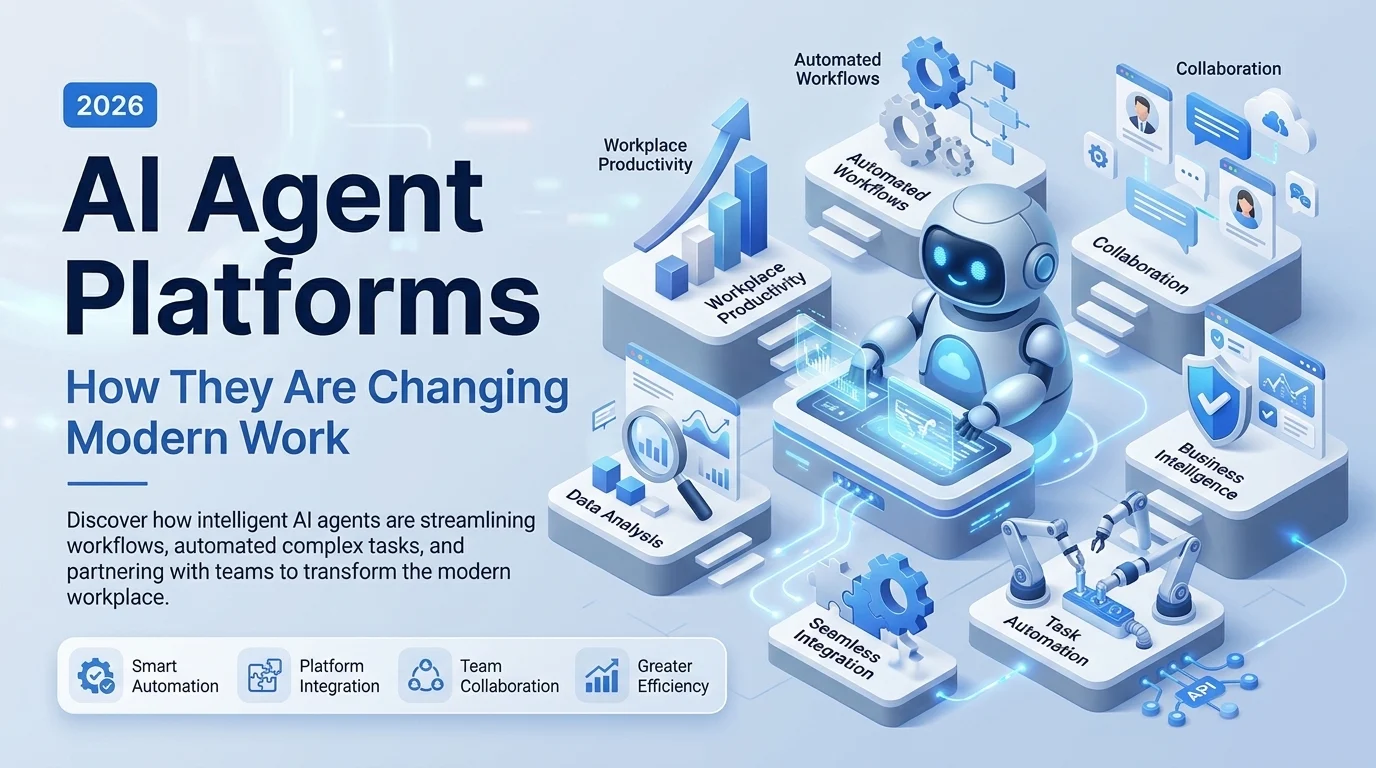

Artificial intelligence is changing the way businesses manage everyday tasks, organize information, and make decisions. While traditional AI tools mainly respond to questions or generate content, modern AI agent platforms are taking things further by helping users complete multiple tasks with less manual involvement. These platforms allow organizations to build intelligent systems that can understand instructions, plan actions, interact with different applications, and complete workflows based on specific goals.
From customer support and software development to business operations and data analysis, autonomous AI agents are creating new opportunities for improving productivity. As companies look for more efficient ways to manage their work, understanding how these platforms operate and where they provide value is becoming increasingly important.
What Are AI Agent Platforms?
AI agent platforms are software environments that help developers and businesses create, manage, deploy, and monitor artificial intelligence agents. An AI agent is designed to work toward a particular objective by interpreting information, making decisions, and performing actions through connected tools and systems.
Unlike a basic chatbot that mainly provides answers, an AI agent can follow a sequence of steps to complete a task. For example, a customer service agent might review a support request, search a knowledge base, identify the issue, prepare a response, and forward complicated cases to a human representative.
These platforms provide the infrastructure needed to connect AI models with business applications, databases, APIs, and other digital resources. They also offer tools for managing permissions, monitoring activities, and controlling how agents interact with important systems.
How AI Agent Platforms Work
Most AI agent platforms combine several technologies to help artificial intelligence perform tasks beyond simple text generation. Although individual products have different architectures, their general operation follows a similar process.
Understanding the objective: The agent receives an instruction or identifies a task that needs attention. It analyzes the available information to understand the expected result.
Planning the steps: The system divides a larger objective into smaller actions. It determines which tools, information sources, or applications may be needed.
Using connected tools: Depending on its permissions, the agent can interact with APIs, databases, business applications, and other resources to perform specific operations.
Reviewing the results: The agent checks the information returned by connected systems and determines whether additional steps are required.
Completing the task: After carrying out the permitted actions, the agent provides the result or requests human approval when a decision requires additional attention.
This process allows AI agents to handle more complex activities than traditional rule-based automation. However, their reliability depends on model quality, available information, system integrations, and appropriate supervision.
Key Features of Modern AI Agent Platforms
When evaluating different AI agent platforms, businesses should look beyond basic automation features. A useful platform should provide the tools needed to build reliable agents and manage their activities over time.
Workflow Automation
Workflow automation allows AI agents to complete repetitive activities across connected applications. For example, an agent may collect information from incoming requests, organize relevant records, and prepare updates for an internal team. This reduces manual work and helps employees focus on tasks that require human judgment.
Multi-Agent Coordination
Some platforms support multiple specialized agents working together. One agent might collect information, another could analyze it, and a third could prepare a report. This approach can help organizations divide complicated workflows into smaller responsibilities.
Application Integrations
Integrations connect agents with the software businesses already use. These connections may include customer relationship management systems, project management applications, communication tools, databases, and external APIs.
Security and Access Controls
AI agents may interact with sensitive business information or perform actions within important systems. Permission management, authentication, activity logs, and approval mechanisms help organizations maintain control over these operations.
Monitoring and Performance Evaluation
Monitoring tools help administrators review agent activities, identify errors, measure performance, and understand how resources are being used. Testing and continuous evaluation are particularly important before allowing agents to perform important business tasks.
How AI Agent Platforms Are Changing Modern Work
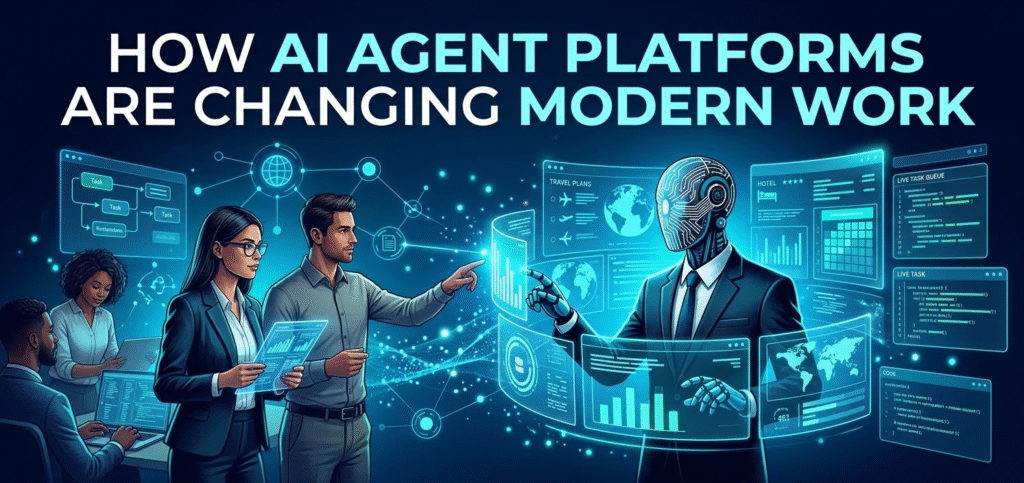
The growing use of autonomous AI agents is influencing several areas of business operations. Instead of replacing every existing process, these systems often support employees by handling specific activities and coordinating information across departments.
Improving Customer Support
Customer support teams receive large numbers of questions about products, services, orders, and account issues. AI agents can review incoming requests, retrieve relevant information, prepare responses, and route complex cases to human representatives.
This approach can improve response times while allowing support employees to spend more time resolving difficult customer problems.
Supporting Software Development
Development teams can use AI agents to assist with code analysis, documentation, testing, and issue investigation. Depending on their permissions, agents may also interact with development tools and repositories to suggest or prepare changes.
Human developers should still review important code modifications, particularly when changes affect security, production systems, or application performance.
Automating Business Operations
Many business processes involve moving information between different applications. AI agents can help coordinate activities such as invoice processing, employee onboarding, document organization, and internal request management.
For example, an agent could extract information from an invoice, compare it with available records, and prepare it for approval. Human review remains important for financial decisions and exceptions.
Helping With Research and Data Analysis
AI agents can gather information from approved sources, organize findings, compare records, and prepare summaries. Research teams can use these capabilities to reduce repetitive information-gathering work.
The accuracy of the final results still depends on the quality of the sources and the ability to verify important findings.
Popular Technologies Behind AI Agent Platforms
Several technologies support the development of modern AI agents. Large language models help systems understand instructions and generate responses, while APIs allow them to communicate with external applications.
Orchestration frameworks coordinate different steps within an agent workflow. Retrieval-augmented generation can connect agents with relevant information from organizational documents and knowledge bases.
Tools such as LangGraph, CrewAI, and Microsoft Copilot Studio represent different approaches to building or configuring agent-based workflows. Businesses should compare their capabilities, integration options, deployment requirements, and governance features before selecting a solution.
Challenges Businesses Should Consider
Despite their potential benefits, AI agent platforms introduce challenges that organizations should address before large-scale deployment.
One concern is inaccurate output. An agent may misunderstand an instruction, retrieve incorrect information, or perform an unsuitable action. Testing with realistic scenarios can help identify these problems before deployment.
Data security is another important consideration. Businesses need to understand which information agents can access, how that information is processed, and whether connected applications have appropriate permissions.
Operating costs also deserve attention. Model usage, API requests, infrastructure, and monitoring can increase expenses as workflows become more complex.
Finally, excessive autonomy can create operational risks. Organizations should establish clear approval requirements for sensitive activities, maintain activity records, and provide a way to pause or stop an agent when necessary.
How to Choose the Right AI Agent Platform
Selecting an appropriate platform starts with identifying the problem a business wants to solve. A company focused on customer service may need strong CRM integrations, while a software team may prioritize development tools and flexible agent orchestration.
Before making a decision, consider the following factors:
- Ease of use: Determine whether the platform supports the technical skills available within your team.
- Integration support: Check whether it connects with your existing applications and data sources.
- Security: Review authentication, access permissions, and monitoring capabilities.
- Scalability: Consider whether the platform can support additional workflows as business requirements grow.
- Cost management: Evaluate model usage, infrastructure expenses, and ongoing operational costs.
- Human oversight: Look for approval controls and clear options for reviewing important agent actions.
Testing a platform through a small pilot project can help businesses understand its practical value before expanding its use.
The Future of AI Agent Platforms
AI agent platforms are likely to become an increasingly important part of modern business technology. Improvements in reasoning, application connectivity, and workflow orchestration may allow agents to handle more complex responsibilities across different departments.
However, successful adoption will require more than powerful AI models. Organizations will need reliable data, clear operating policies, effective security controls, and employees who understand how to supervise automated systems.
Rather than removing the need for human involvement, the most practical approach is to combine AI capabilities with human experience and decision-making. Businesses that introduce automation carefully can use AI agents to reduce repetitive work while maintaining accountability.
Frequently Asked Questions
What is the main purpose of AI agent platforms?
Their main purpose is to help businesses build and manage AI agents that can understand objectives, use connected tools, and complete multi-step tasks within defined permissions.
How are AI agents different from chatbots?
Traditional chatbots primarily respond to user questions, while AI agents can plan and perform actions across connected applications to achieve specific objectives.
Can small businesses use AI agent platforms?
Yes. Small businesses can use agent-based tools for activities such as customer support, document processing, scheduling, and workflow automation. The right solution depends on their requirements, technical resources, and budget.
Are AI agent platforms safe for business use?
They can be used responsibly when organizations apply appropriate access controls, testing, monitoring, data protection measures, and human approval for sensitive operations.
Do AI agents replace human employees?
AI agents can automate certain repetitive activities, but human employees remain important for supervision, complex decisions, communication, and responsibilities that require professional judgment.
Conclusion
AI agent platforms are changing modern work by connecting artificial intelligence with business applications, data, and automated workflows. From customer support and software development to research and daily operations, these systems can help organizations complete repetitive tasks more efficiently.
Their long-term value will depend on choosing suitable applications, maintaining strong security practices, and ensuring that people remain involved in important decisions. With a thoughtful implementation strategy, businesses can make AI agents a practical part of their everyday operations.