
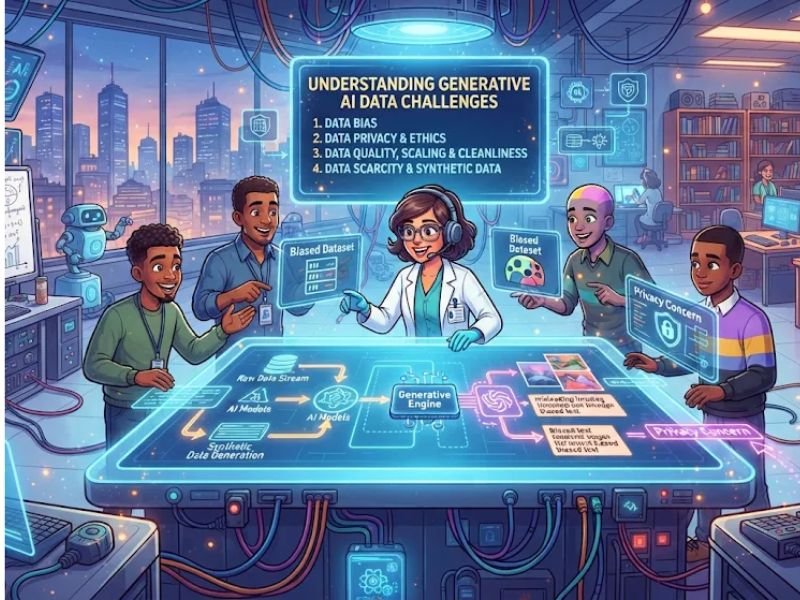

Generative AI is transforming modern technology by enabling machines to create text, images, videos, code, audio, and other digital content. From AI chatbots and virtual assistants to automated content creation tools, these technologies rely on large amounts of data to deliver meaningful results. However, behind their impressive capabilities are several Generative AI Data Challenges that can affect accuracy, reliability, security, and overall performance.
As businesses continue adopting generative AI in their daily operations, understanding these data-related problems becomes increasingly important. Poor-quality information, limited datasets, privacy concerns, and biased training materials can prevent AI systems from producing dependable outputs. Addressing these challenges is essential for organizations that want to develop useful, trustworthy, and scalable AI applications.
What Are Generative AI Data Challenges?
Generative AI data challenges refer to the problems organizations encounter when collecting, preparing, processing, storing, and using data to develop AI models. Generative AI systems learn patterns from training datasets, which help them generate responses, predictions, and creative content.
The quality and diversity of this information directly influence how well an AI model performs. If the training data is incomplete, outdated, inaccurate, or poorly organized, the resulting model may struggle to understand context and generate useful answers.
Unlike traditional software that follows predefined instructions, generative AI depends heavily on patterns learned from data. This makes data management a critical part of modern AI development.
1. Poor Data Quality and Accuracy
One of the biggest challenges in generative AI development is maintaining high-quality training data. AI models require accurate, relevant, and well-structured information to learn effectively. However, datasets often contain duplicate records, outdated content, incorrect facts, missing values, or inconsistent formatting.
When AI systems learn from unreliable information, they may produce misleading answers, incorrect recommendations, or content that lacks factual accuracy. These problems can reduce user trust and negatively affect business decisions.
Developers can improve data quality by implementing validation processes, removing duplicate records, regularly updating datasets, and reviewing information before using it for training. Consistent data cleaning helps AI models produce more reliable results.
2. Data Privacy and Security Concerns
Generative AI applications frequently process sensitive information, including customer details, business documents, financial records, and internal communications. Using this information for model training or AI-powered analysis can create privacy and security risks.
Unauthorized access, data leakage, and improper information handling may expose confidential details. Businesses must also consider privacy regulations and the responsibilities associated with collecting and processing personal data.
To reduce these risks, organizations should use data anonymization, encryption, access controls, and secure storage systems. They should also establish clear policies regarding which information can be shared with AI tools and how it should be processed.
3. Data Bias and Unbalanced Datasets
AI models can inherit biases present in their training data. If datasets contain limited perspectives, unequal representation, or historical discrimination, generative AI may produce biased or unfair responses.
For example, an AI recruitment tool trained on unbalanced hiring data may favor certain candidate profiles over others. Similarly, a chatbot trained primarily on information from one region may struggle to provide culturally relevant answers to users from different backgrounds.
Reducing bias requires diverse datasets, regular testing, and continuous evaluation. Developers should examine how AI systems respond to different users, languages, backgrounds, and scenarios to identify potential problems before deployment.
4. Limited Availability of High-Quality Data

Developing advanced generative AI models requires substantial amounts of relevant training data. However, finding high-quality information that is accessible, legally usable, and suitable for a particular purpose can be difficult.
Some industries have limited digital information, while others rely on proprietary records that cannot easily be shared. Specialized AI applications may also require expert-reviewed datasets that are expensive and time-consuming to collect.
Businesses can address this problem through carefully managed data partnerships, licensed datasets, synthetic data generation, and domain-specific data collection. These approaches can help improve dataset availability without compromising quality or legal requirements.
5. Data Preparation and Integration Complexity
Data used in AI development often comes from multiple sources, including websites, databases, documents, APIs, customer platforms, and internal business systems. These sources may use different formats, structures, languages, and standards.
Combining this information into a dataset that generative AI can understand requires significant technical effort. Data preparation may involve cleaning, labeling, formatting, filtering, categorizing, and removing irrelevant content.
Organizations can simplify this process by adopting automated data pipelines, standardized formats, and reliable data management platforms. Efficient preparation allows developers to spend less time fixing data issues and more time improving AI capabilities.
6. Outdated Data and Knowledge Limitations
Generative AI models may rely on training information that does not reflect the latest developments. This can become a serious problem in industries where information changes frequently, including technology, finance, healthcare, marketing, and cybersecurity.
Outdated training data can cause AI tools to provide incorrect product information, outdated recommendations, or responses that ignore recent changes.
Businesses can address this limitation by regularly refreshing relevant datasets and connecting AI systems to updated information sources. Retrieval-augmented generation (RAG) is one approach that allows AI models to retrieve relevant information from external knowledge bases when generating responses, helping improve factual relevance.
7. Managing Data Costs and Scalability
Collecting, storing, processing, and maintaining large datasets requires infrastructure, computing resources, skilled professionals, and ongoing investment. As generative AI projects expand, data-related expenses can increase significantly.
Smaller businesses may struggle to maintain large-scale data infrastructure or access specialized expertise. Meanwhile, growing datasets can introduce additional challenges related to storage capacity, processing speed, and data governance.
Organizations should prioritize relevant data, optimize storage systems, automate repetitive tasks, and choose infrastructure based on their actual requirements. A well-planned data strategy can help businesses manage costs while supporting long-term AI growth.
How Businesses Can Overcome Generative AI Data Challenges
Overcoming data-related problems requires a structured approach rather than relying on AI models alone. Businesses should establish clear data governance policies, conduct regular quality assessments, protect sensitive information, and monitor model outputs.
Investing in data engineering, AI expertise, and automated workflows can also improve the development process. Organizations should begin with smaller, carefully evaluated datasets before expanding their AI projects.
Continuous monitoring is equally important because data quality, user expectations, and business requirements change over time. Regular evaluations help identify emerging problems and keep AI systems aligned with organizational goals.
Conclusion
Generative AI offers significant opportunities for businesses, developers, and technology professionals, but its success depends heavily on the quality and management of data. Data privacy, bias, accuracy, availability, integration, and scalability remain important obstacles in modern AI development.
Understanding these Generative AI Data Challenges allows organizations to make better decisions, build more reliable applications, and reduce risks during implementation. By adopting responsible data practices and investing in effective data management, businesses can unlock the full potential of generative AI and support more sustainable innovation.