
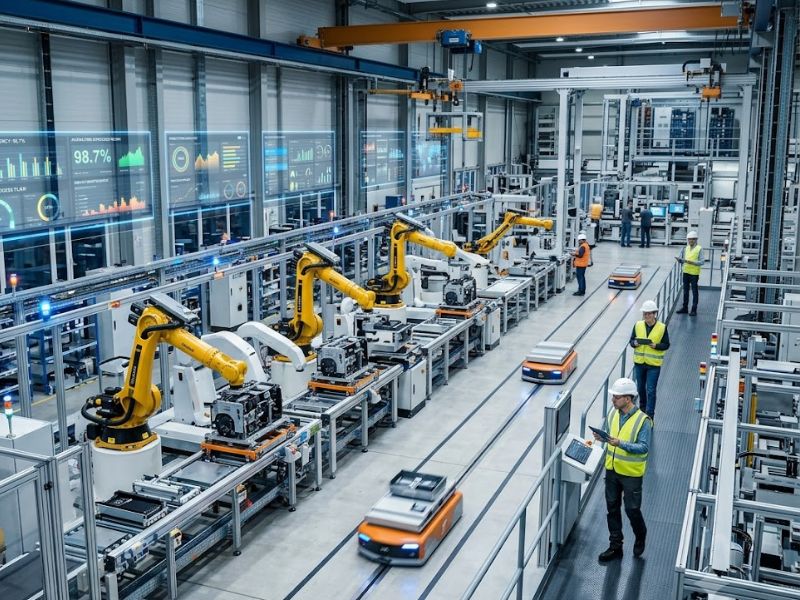

Manufacturing is undergoing a major transformation as automation technologies become more advanced and widely adopted. From robotic assembly lines to artificial intelligence (AI) and the Industrial Internet of Things (IIoT), modern factories are becoming smarter, faster, and more efficient. As businesses strive to improve productivity and remain competitive, the future of automation is shaping a new era of manufacturing.
This article explores how automation is revolutionizing manufacturing, the technologies driving smart factories, the benefits and challenges involved, and what the future holds for the industry.
What Is Manufacturing Automation?
Manufacturing automation is the use of technology, machinery, robotics, and software to perform production tasks with minimal human intervention. Automated systems can handle repetitive processes, monitor equipment, inspect product quality, and manage production lines more accurately than traditional manual methods.
Automation allows manufacturers to produce goods faster while reducing errors, improving consistency, and lowering operational costs.
What Are Smart Factories?
A smart factory is a highly digitalized manufacturing facility where connected machines, sensors, and software communicate in real time. Smart factories use data analytics, AI, cloud computing, and IoT devices to optimize production, predict equipment failures, and improve overall efficiency.
Unlike traditional factories, smart factories continuously collect and analyze data, allowing businesses to make informed decisions and quickly adapt to changing market demands.
Key Technologies Driving the Future of Automation
Artificial Intelligence (AI)
AI enables machines to analyze large amounts of production data, identify patterns, and make intelligent decisions. Manufacturers use AI to optimize production schedules, improve quality control, and predict maintenance needs before equipment fails.
Industrial Internet of Things (IIoT)
IIoT connects machines, sensors, and devices across the factory floor. These connected systems share real-time information, helping manufacturers monitor operations, reduce downtime, and improve overall productivity.
Robotics
Industrial robots perform repetitive and complex tasks such as welding, painting, packaging, and material handling. Modern collaborative robots (cobots) can safely work alongside human employees, increasing productivity without replacing human expertise.
Machine Learning
Machine learning systems improve over time by analyzing production data. These systems help manufacturers detect defects, optimize workflows, and continuously enhance production efficiency.
Digital Twins
A digital twin is a virtual model of a physical machine or production line. Manufacturers use digital twins to simulate operations, test improvements, and predict potential issues before making changes in the real factory.
Cloud Computing
Cloud platforms enable manufacturers to store production data securely and access it from anywhere. Cloud-based systems improve collaboration between facilities and support real-time monitoring across multiple manufacturing locations.
Benefits of Automation in Manufacturing
Increased Productivity
Automated systems operate continuously with minimal interruptions, allowing manufacturers to increase production output while maintaining consistent quality.
Improved Product Quality
Automation reduces human error and ensures products meet strict quality standards through precise manufacturing and automated inspection systems.
Lower Operating Costs
Although automation requires an initial investment, businesses often reduce labor costs, minimize waste, and lower maintenance expenses over time.
Enhanced Workplace Safety
Robots can perform dangerous tasks involving heavy lifting, hazardous chemicals, or extreme temperatures, reducing workplace injuries and improving employee safety.
Predictive Maintenance
Smart sensors continuously monitor equipment performance. AI analyzes this data to predict maintenance needs before costly breakdowns occur, reducing unexpected downtime.
Better Decision-Making
Real-time production data gives managers valuable insights into machine performance, inventory levels, and operational efficiency, enabling faster and more informed business decisions.
Challenges of Manufacturing Automation
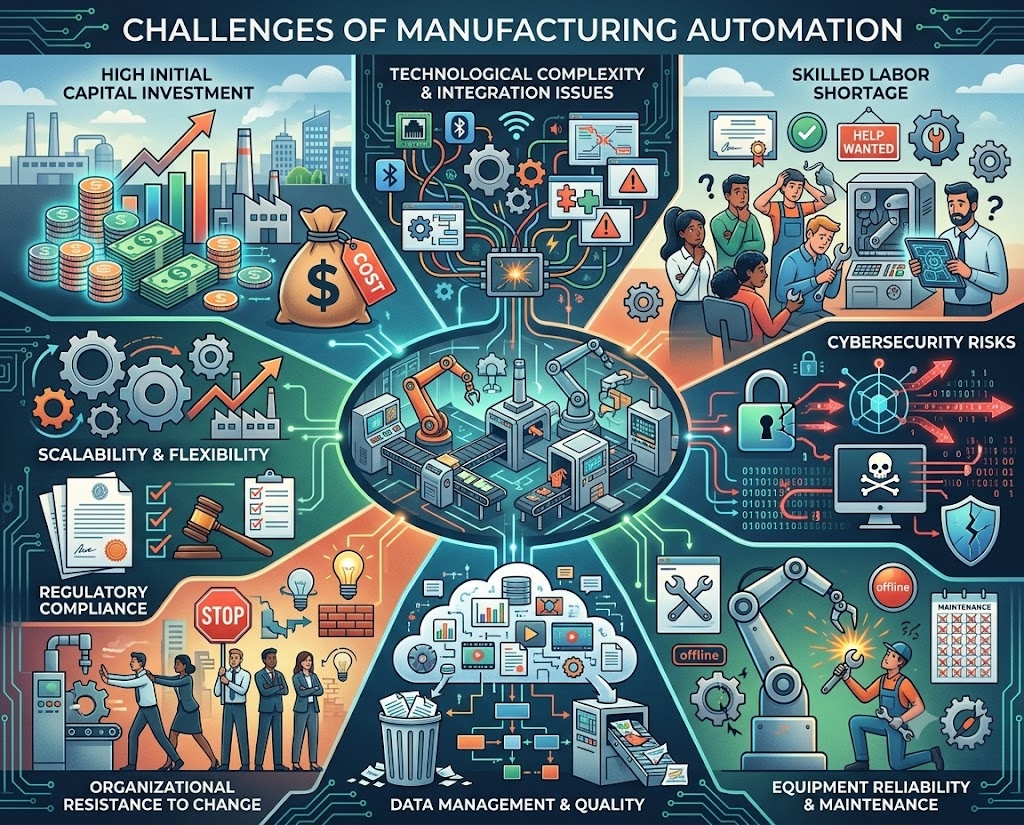
Despite its advantages, automation presents several challenges.
High Initial Investment
Installing advanced robotics, software, and connected infrastructure requires significant capital, especially for small and medium-sized manufacturers.
Workforce Reskilling
As automation handles routine tasks, employees need training in robotics, programming, data analysis, and system management to remain valuable in the modern workplace.
Cybersecurity Risks
Connected manufacturing systems are more vulnerable to cyberattacks. Businesses must invest in strong cybersecurity measures to protect sensitive production data and critical infrastructure.
Integration Complexity
Many manufacturers operate with older equipment that may not easily integrate with modern automation technologies, making implementation more challenging.
Industries Benefiting from Smart Factory Automation
Automation is transforming many industries, including:
- Automotive manufacturing
- Electronics production
- Food and beverage processing
- Pharmaceutical manufacturing
- Aerospace engineering
- Metal fabrication
- Consumer goods manufacturing
- Packaging and logistics
Each industry uses automation differently, but all benefit from improved efficiency, reduced costs, and higher product quality.
Future Trends in Manufacturing Automation
Several emerging technologies will continue to shape the future of automation.
AI-Powered Autonomous Factories
Factories will become increasingly self-managing, using AI to optimize production schedules, monitor quality, and respond automatically to operational changes.
Human-Robot Collaboration
Collaborative robots will work more closely with employees, combining human creativity and decision-making with robotic precision and speed.
Sustainable Manufacturing
Automation will help reduce energy consumption, optimize material usage, and minimize production waste, supporting environmental sustainability goals.
5G Connectivity
High-speed 5G networks will enable faster communication between connected devices, supporting real-time control of smart manufacturing systems.
Advanced Predictive Analytics
Manufacturers will rely on advanced analytics to forecast demand, optimize inventory, and improve supply chain efficiency.
How Businesses Can Prepare
Manufacturers planning to adopt automation should:
- Assess current production processes.
- Identify repetitive tasks suitable for automation.
- Invest in employee training and digital skills.
- Implement strong cybersecurity practices.
- Start with scalable automation projects before expanding.
- Continuously monitor performance using real-time data.
A phased approach helps businesses maximize their return on investment while minimizing operational disruption.
Conclusion
The future of automation in manufacturing and smart factories is creating faster, safer, and more intelligent production environments. Technologies such as artificial intelligence, robotics, IIoT, machine learning, and cloud computing are transforming how products are designed, manufactured, and delivered.
Although challenges such as implementation costs, cybersecurity, and workforce training remain, the long-term benefits far outweigh the obstacles. Manufacturers that embrace automation today will be better positioned to improve efficiency, enhance product quality, reduce costs, and remain competitive in an increasingly digital global economy. By investing in smart factory technologies and continuous innovation, businesses can build resilient manufacturing operations ready for the future.