


Introduction
Cybersecurity threats continue to evolve as businesses become more dependent on software, cloud computing, and connected digital systems. Security vulnerabilities in widely used technologies can create serious challenges for developers and organizations. One such concern attracting attention in November 2026 is Java4Shell, a vulnerability affecting certain OpenJDK environments.
Tracked as CVE-2026-114938, Java4Shell involves a memory-corruption issue in the Java Base64 decoder. Under specific hardware and software conditions, attackers may exploit this weakness to execute unauthorized code remotely. The vulnerability has raised concerns because Java supports numerous enterprise applications, web services, and business systems.
The discovery of Java4Shell highlights the importance of software security, regular vulnerability assessments, and timely security updates. Understanding how this issue works and what organizations can do to reduce exposure is essential for maintaining a secure digital environment.
What Is Java4Shell?
Java4Shell is a security vulnerability in OpenJDK, the open-source implementation of the Java platform. It affects the Base64 decoding functionality used by Java applications to process encoded information.
The vulnerability is identified as CVE-2026-114938 and involves memory corruption in an optimized Base64 decoder implementation.
Base64 is commonly used to represent binary information as text. Applications may use it when processing authentication credentials, digital tokens, file attachments, and other encoded information.
Under specific conditions, specially crafted input can trigger the vulnerable decoding process and cause memory corruption. Successful exploitation may allow remote code execution within an affected Java process.
The issue is particularly important because Java is widely used in enterprise applications, making software inventory and timely patching essential.
Why Java4Shell Is Changing the Cybersecurity Landscape in 2026
Java4Shell demonstrates how vulnerabilities in fundamental software components can affect applications across multiple industries.
Unlike vulnerabilities limited to one particular website or application, this issue exists within the Java runtime environment. Consequently, different applications using affected Java builds may face exposure if the required exploitation conditions are present.
The discovery also highlights several important cybersecurity challenges.
1. Risks Associated With Core Software Components
Many organizations focus their security efforts on applications, websites, and network infrastructure. However, vulnerabilities can also exist in the underlying technologies that support these systems.
Java4Shell demonstrates why organizations need to monitor programming languages, runtime environments, libraries, and third-party software.
A vulnerability in a commonly used component can create risks for multiple applications simultaneously.
2. Increasing Importance of Software Supply Chain Security
Modern applications depend on multiple software components developed by different organizations.
Businesses may use commercial applications, open-source libraries, container images, and third-party services without knowing every underlying component.
If an important dependency contains a security vulnerability, all applications relying on the affected component may require attention.
Java4Shell reinforces the need for software inventories, dependency monitoring, and communication with technology vendors.
3. Remote Code Execution Risks
Remote code execution is among the most serious categories of cybersecurity vulnerabilities because it can allow attackers to run unauthorized instructions on affected systems.
Java4Shell has been reported to allow remote code execution without authentication under specific conditions.
Depending on the permissions of the affected Java process, successful exploitation could lead to unauthorized access, service disruption, or further compromise.
Organizations should therefore prioritize vulnerable internet-facing applications and systems handling sensitive information.
How Does the Java4Shell Vulnerability Work?
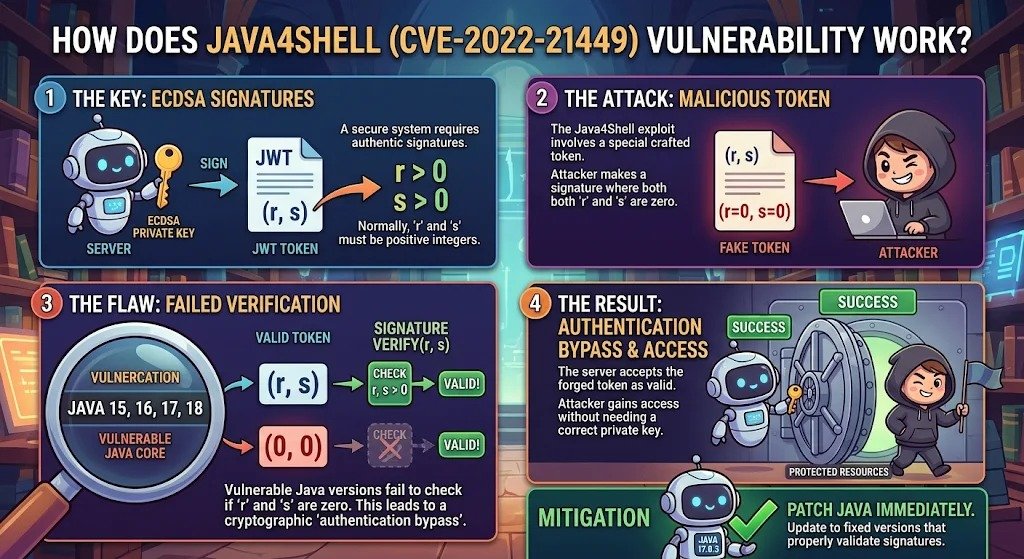
Java4Shell is associated with an optimized Base64 decoding process in OpenJDK.
Modern processors support advanced instructions that can improve software performance. Java uses certain hardware-accelerated operations to make some tasks faster.
However, an error in the affected optimized decoding implementation can result in memory corruption when processing specially crafted input.
The vulnerability requires particular conditions, including an affected Java runtime, compatible x86-64 hardware supporting AVX-512 VBMI instructions, and an application processing attacker-controlled Base64 data through the vulnerable decoder.
This means not every Java installation is automatically exploitable.
The vulnerability is different from Log4Shell, which affected the Log4j logging library. Java4Shell involves the Java runtime’s Base64 decoder rather than the Log4j component.
Understanding this distinction helps developers identify the correct software component that requires attention.
Which Systems May Be Affected?
Java4Shell primarily concerns certain OpenJDK and related Java environments.
According to published security advisories, affected environments include specific Java 17 and later runtime builds running on compatible x86-64 processors.
Some Oracle Java, GraalVM, and vendor-provided OpenJDK distributions also require attention.
However, exposure depends on the exact Java build, processor capabilities, runtime configuration, and application behavior.
Organizations should not assume that every Java-based application is vulnerable. Instead, administrators should identify the Java runtime used by each service and compare its version with the relevant vendor security advisory.
How Java4Shell Affects Businesses and Developers
The potential impact of Java4Shell extends beyond individual software applications.
For businesses, a successful attack could create operational disruption, unauthorized access, and possible exposure of sensitive information.
Companies operating customer portals, authentication systems, enterprise applications, and online services should pay particular attention to vulnerable Java environments.
Developers may also need to review how their applications process encoded information.
Security teams should consider the following areas:
- Java runtime versions used by production applications.
- Third-party software containing bundled Java environments.
- Internet-facing services that process user-controlled data.
- Authentication systems and applications handling encoded credentials.
- Container images and cloud deployments using affected runtimes.
A complete assessment can help organizations identify systems that require immediate updates.
Effective Ways to Protect Against Java4Shell
Organizations can reduce Java4Shell exposure by following vendor security recommendations and improving their software maintenance practices.
1. Install Available Security Updates
Oracle and OpenJDK released security fixes for Java4Shell on November 17, 2026.
Administrators should identify affected installations and upgrade them to the appropriate patched versions recommended by their Java vendor.
Updating the application alone may not be sufficient if it continues to use a vulnerable bundled Java runtime.
2. Check Java Runtime Versions
System administrators should review installed Java versions using the following command:
They should also check the runtime used by individual applications, containers, and enterprise software.
A system may contain multiple Java installations, so checking only the default runtime can leave vulnerable components unnoticed.
3. Review Hardware Compatibility
The vulnerability is associated with a specific accelerated code path involving AVX-512 VBMI instructions.
Security teams should identify whether affected Java environments are running on compatible x86-64 hardware.
This helps organizations understand which systems may meet the hardware requirements for exploitation.
4. Apply Temporary Mitigations When Necessary
If immediate patching is not possible, administrators can review vendor-recommended temporary mitigations.
One documented option is:
-XX:-UseBASE64Intrinsics
This disables the affected hardware-accelerated Base64 implementation.
Another option is:
-XX:UseAVX=2
This disables AVX-512 instruction paths, although it may affect performance.
These workarounds should be applied according to vendor guidance and tested before deployment. They are temporary measures and should not replace installing the permanent security update.
5. Monitor Systems for Suspicious Activity
Organizations should monitor application logs, authentication events, endpoint activity, and network traffic.
Unexpected application crashes, unusual requests, and suspicious process behavior may require investigation.
Security teams should also review incident response procedures to ensure that potential compromises can be handled quickly.
The Future of Cybersecurity After Java4Shell
Java4Shell highlights the importance of proactive cybersecurity in an environment where software dependencies are becoming increasingly complex.
Organizations can no longer focus exclusively on protecting their visible applications. They must also monitor programming language runtimes, operating systems, hardware configurations, and third-party components.
Software supply chain security, automated vulnerability detection, and continuous monitoring are likely to become even more important.
Artificial intelligence may also help security professionals identify suspicious behavior and analyze vulnerabilities more efficiently. However, automated security tools should complement rather than replace experienced developers and security teams.
The Java4Shell incident is another reminder that regular software updates and responsible vulnerability management are essential for modern organizations.
Conclusion
Java4Shell is an important cybersecurity development in 2026 because it highlights the risks associated with vulnerabilities in widely used software environments. The OpenJDK Base64 decoder issue demonstrates how a weakness in a fundamental technology can potentially affect different applications and enterprise systems.
Although exploitation depends on specific hardware and software conditions, organizations should take the vulnerability seriously. Identifying affected Java installations, applying security updates, reviewing bundled runtimes, and monitoring suspicious activity can help reduce potential risks.
As digital infrastructure continues to expand, businesses and developers must prioritize software security at every level. Java4Shell reinforces the importance of proactive vulnerability management and timely security updates in protecting modern digital systems.